The Front
By Chantelle Trainor-Matties
We acknowledge that we live and work on unceded Indigenous territories and we thank the Musqueam, Squamish and Tsleil-Waututh Nations for their hospitality.
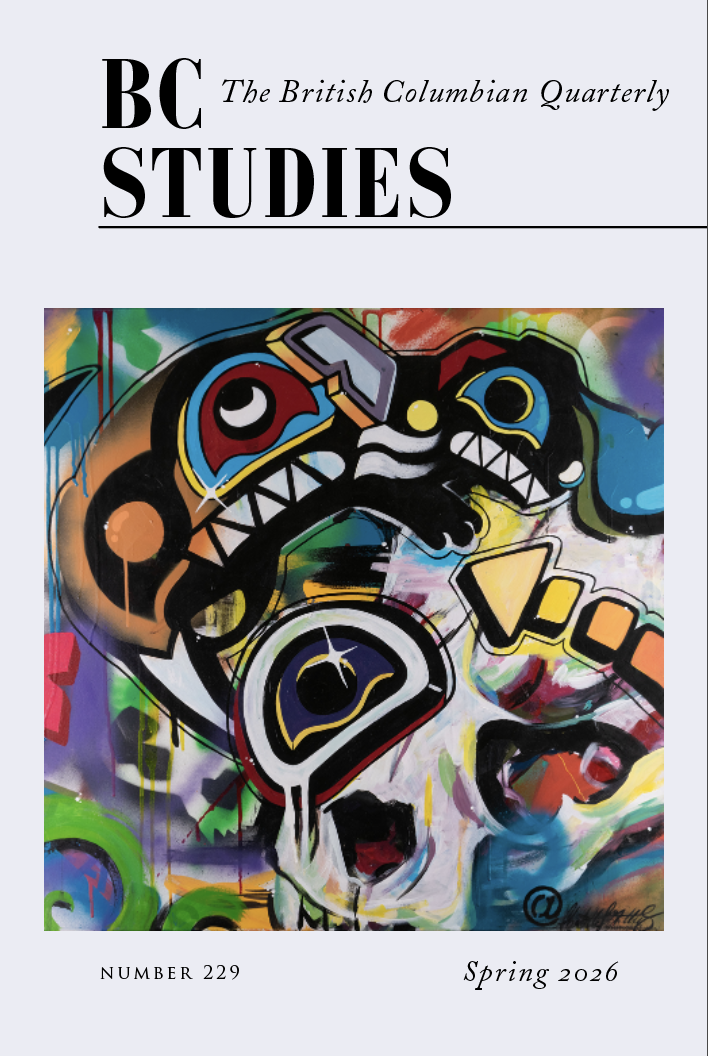
BC Studies no. 229 Spring 2026
Featuring cover artwork by Chantelle Trainor-Matties; ARTICLES by Adele Perry, Grant W. Grams, Frank Leonard, Chris Madsen, and Rheanne Krochinsky and John Richard Wagner; SOUNDWORKS by Julie Andreyev, Julian Evans, Hildegard Westerkamp, and Toni-Leah C. Yake.
The issue will be open access 2027-06-15
To read the full issue online, visit our OJS site.
Or, order a print copy today!
ISSN 0005-2949 (Print)
ISSN 2819-5582 (Online)
In This Issue
By Chantelle Trainor-Matties
Ellen Neel: First North West Coast Female Carver Revived Totem Pole Culture
By Dianne Meili
BC Studies no. 229 Spring 2026 p. 5-8
By Grant W. Grams
BC Studies no. 229 Spring 2026 pp. 27-43
By Frank Leonard
Riding with Angels: Mounties and Gypsy Wheelers in White Rock
By Chris Madsen
BC Studies no. 229 Spring 2026 pp. 71-107
By Rheanne Kroschinsky and John Richard Wagner
BC Studies no. 229 Spring 2026 pp. 109-133
Listening in Relation: Soundscapes from the Listening Room
By Julie Andreyev, Julie Evans, Hildegard Westerkamp, and Toni-Leah C. Yake
BC Studies no. 229 Spring 2026 pp. 135-141

Native Plants of British Columbia’s Coastal Dry Belt
By David E. Giblin
BC Studies no. 229 Spring 2026 pp. 147-148
The Final Spire: ‘Mystery Mountain’ Mania in the 1930s
By PearlAnn Reichwein
BC Studies no. 229 Spring 2026 pp. 148-150
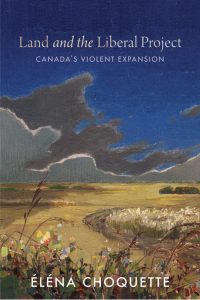
Land and the Liberal Project: Canada’s Violent Expansion
By Mckelvey Kelly
BC Studies no. 229 Spring 2026 pp. 150-151
The Teachings of Mutton: A Coast Salish Woolly Dog
By Brandon Gabriel
BC Studies no. 229 Spring 2026 pp. 151-153

Julie Andreyev is an artist, researcher and educator in so-called Vancouver, the unceded territories of the xʷməθkʷəy̓əm, Sḵwx̱wú7mesh, and səl̓ilw̓ətaʔɬ Nations. Her multispecies studio explores more-than-human creativity to develop kinships with local lifeforms and ecologies. The research investigates methods of creative reciprocity using non-invasive technologies. Projects take form as land-based sound art, video, media installation, and long-term tending. Andreyev has a PhD from Simon Fraser University and is associate professor and co-director of the Basically Good Media Lab at Emily Carr University of Art + Design.
Julian Evans is a writer, educator, and sound artist with a PhD in theory and criticism from Western University. His teaching and research spans philosophy, political ecology, political theory, and sound studies, focusing on how sonic perception and imagination shape our relationships with place.
Grant W. Grams is a historian and educator specializing in German history, European migration, and Canadian social history, with particular emphasis on developments in the late nineteenth and twentieth centuries. Dr. Grams joined Athabasca University in 2009, where he continues to serve as a historian and academic expert within the Faculty of Humanities and Social Sciences.
Rheanne Kroschinsky is a PhD candidate at University of British Columbia Okanagan, where her community-engaged research is focused on British Columbian watershed governance. Her work, made possible through the Social Sciences and Humanities Research Council of Canada and the University of British Columbia, Okanagan, explores governance and decision-making frameworks for community (source) watersheds in British Columbia. Rheanne is a visiting governance graduate student fellow at the University of Victoria’s Centre for Global Studies, POLIS Water Sustainability Project.
Frank Leonard is an adjunct associate professor in the Department of History of the University of Victoria. He has investigated elements of infrastructure development in western Canada and the United States by using different types of business records to illuminate contradictions within road, rail, and energy projects.
Chris Madsen is a professor in the Defence Studies Department at the Canadian Forces College and Royal Military College of Canada in Toronto, Ontario. He teaches military officers and senior public servants on the National Security Programme and Joint Command and Staff Programme. His research interests include national security policing, transnational organized crime, seaport policing, military support to law enforcement, shipbuilding, naval history, and Canadian military law. He resides in North Vancouver and South Surrey.
Adele Perry is a settler historian of nineteenth- and twentieth-century Canada. She has taught at the University of Manitoba since 2000, where she directs the Centre for Human Rights Research, and is working on a book on the Hudson’s Bay Company and colonial authority.
John Wagner is professor emeritus at UBC Okanagan in the Department of Community, Culture, and Global Studies. He is an
environmental anthropologist whose research focuses on water governance, food systems, and settler colonialism in the Okanagan Valley, British Columbia, and the Columbia River Basin in Canada and the United States. He also conducts environmental research in Papua New Guinea, where he is currently involved in a language documentation project in partnership with six Kala communities.
Hildegard Westerkamp is a prolific sound activist, composer, and soundscape educator. Her compositions and written work are known in many parts of the world. With her expert ear carefully attuned to the world around her, Westerkamp has become a household name for pioneering soundscape composition and the practice of “soundwalking.” In 2024 she received an honorary Doctor of Fine Arts degree, honoris causa, from Simon Fraser University.
Toni-Leah C. Yake (Euro-settler; Kanyen’kehà:ka, Six Nations of the Grand River Territory, Turtle Clan) is a composer-performer currently based on the unceded territories of the xʷməθkʷəy̓əm, Sḵwx̱wú7mesh, and səl̓ilw̓ətaʔɬ Nations. Her interdisciplinary practice engages with themes of land, memory, world-building, and embodied response. Informed by dream interpretation and Kanyen’kehà:ka epistemologies, Yake’s performances frequently navigate liminality through the integration of archival recordings, synthesis, and noise-based sound practices. Grounded in ongoing Kanyen’kéha (Mohawk language) research, her work explores the interplay between conscious and unconscious experience, symbolic resonance, relationships with unseen dimensions, and the invocation of ancestral and archaic memory.
About
Issues
Submissions
Resources
News & Events
Shop