
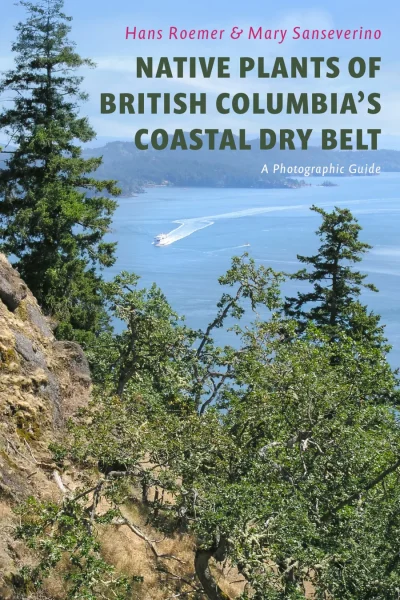
Native Plants of British Columbia’s Coastal Dry Belt
Review By David E. Giblin
May 7, 2026
BC Studies no. 229 Spring 2026 | p. 147-148
The late Dr. Hans Roemer and co-author Mary Sanseverino have made an outstanding contribution to the rich body of Pacific Northwest botanical literature with their book, “Native Plants of British Columbia’s Coastal Dry Belt”. The focus of their 264-page photo-based field guide is the identification of the most common native plants of the low elevation and coastal plant communities occurring in the rain-shadow zone that occurs in southeastern Vancouver Island and from southwestern mainland British Columbia to northwestern Washington (map provided in the introductory pages). Having spent five years conducting botanical surveys throughout Washington’s San Juan Islands, I am biased about the beauty and conservation value of these plant communities.
The book is organized into three main sections: Native Plants of Forest and Garry Oak Ecosystems, Native Plants of Wetlands and Coastal Habitats, and Additional Native Plants of Interest. Within each section there are subsections, each with a brief description introducing each section along with color photographs from the field. The layout allows users to easily navigate among plant communities and habitat types based on where they may be venturing. As I perused each section, I could see in my minds’ eye places in the San Juan Islands that matched the descriptions and photographs provided. The clarity of text and tight narrative alignment of the photos is impressive.
Of the book’s many virtues, perhaps most salient is the authors’ perspective that learning plants by community/habitat type, and only the most common and abundant ones at that, makes learning the more than 500 species addressed in the book much easier. In the authors’ own words: “With just a few species to concentrate on at a time, it is easy to identify them using the accompanying photographs.” The referenced photographs are outstanding (no small feat!), as they provide enough detail and a variety of angles to make lining up plants seen with plants in the book as straightforward as possible.
Another aspect of the book that I enjoyed is the use of contemporary taxonomy and nomenclature with respect to scientific names. For example, in this book you will find Erythranthe (monkeyflowers), Primula (shooting-star), and Lamium (yellow archangel). If you know these plants as Mimulus, Dodecatheon, and Lamiastrum, respectively, you can still find those names in the index, which will point you to the name currently in use.
There were a few aspects of the guide that left me wanting to ask the authors why they made some of the choices that they did. For example, they list both Turritis glabra (tower mustard) and Silene antirrhina (sleepy catchfly) as non-native. I am not aware of any other resources that considers these species as introduced. I didn’t understand why the dry belt zone in Washington did not include all of Whidbey Island given its consistently low elevation and similarly low level of precipitation as other parts of the island that fell within the dry belt zone. These are small matters that only finicky botanists like me are likely to ponder – they in no way detract from the utility of the book and the time-earned insights that it will deliver to users.
This is a wonderful field guide that anyone who spends time in this beautiful and botanically rich corner of the Pacific Northwest should carry with them. Even if you already know the plants, there is plenty to learn from this book!
Publication Information
Roemer, Hans and Mary Sanseverino. Native Plants of British Columbia’s Coastal Dry Belt. Madeira Park: Harbour Publishing, 2025. 272pp. $29.95 paper.