Where the Power Is: Indigenous Perspectives on Northwest Coast Art
Review By Alexandra Peck
August 5, 2025
BC Studies no. 226 Summer 2025 | p. 158-160
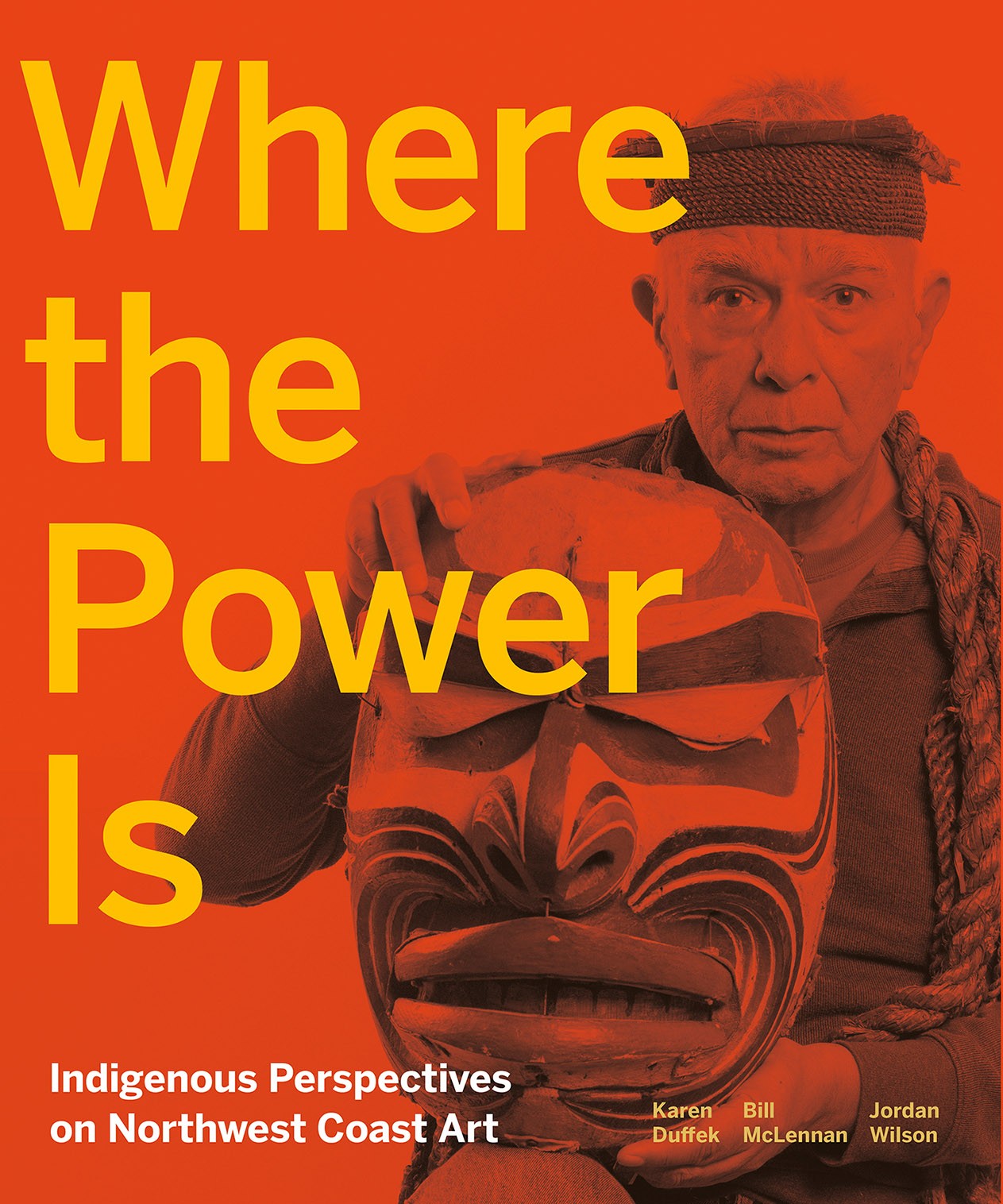
A thoroughly collaborative monograph, Where the Power Is: Indigenous Perspectives on Northwest Coast Art (2021) challenges notions of hierarchical knowledge systems and instead promotes multifaceted interpretations of Indigenous possessions housed at the University of British Columbia’s Museum of Anthropology (MOA). The book is co-authored by MOA Curator of Contemporary Visual Arts & Pacific Northwest Karen Duffek, the late and great MOA Curator of Pacific Northwest Bill McLennan, and NYU doctoral candidate in Anthropology Jordan Wilson, a burgeoning Musqueam scholar. Complementing the authors’ myriad scholarly specialties and professional expertise are the insights and knowledge of more than 80 contemporary Northwest Coast Indigenous artists, Elders, linguists, and cultural practitioners, whose voices comprise the bulk of the volume. Select objects from MOA are organized into three traditional Northwest Coast geographic areas (South, Central, and North), with belongings such as an ornately carved Coast Salish spindle whorl constituting the “Southern” region, a colorful Kwakwaka’wakw Earthquake mask representing the “Central” district, and an elegant seal-shaped bowl emanating from Haida territory to characterize the “North.” Each object is accompanied by commentary and interview excerpts from Indigenous collaborators, enhanced by more than 300 color photographs that provide precise detail of every object. Collaborators’ perspectives and comprehension of these pieces provide insider knowledge that is often lacking within museum spaces and curatorial catalogues, thus offering a refreshing means of reinterpreting Northwest Coast material culture—through the eyes of makers and descendants, rather than those of curators and academic scholars.
It many ways, Where the Power Is presents itself as a modern ethnographic study of a museum collection. Its layout and purpose echoes that of Yup’ik Elders at the Ethnologisches Museum Berlin: Fieldwork Turned on Its Head, the 2005 publication by Ann Fienup-Riordan that provides Yup’ik commentary on cultural patrimony held at German anthropological museums, or Atiqput: Inuit Oral History & Project Naming (a 2022 book that utilizes Inuit knowledge and family histories to identify unnamed Inuit individuals who posed for historical ethnological photographs). We witness a similar approach in Bill Holm and Bill Reid’s foundational Form & Freedom: A Dialogue on Northwest Coast Indian Art (1975), which combined Reid’s Haida insights with Holm’s museological perspective. However, Duffek, McLennan, and Wilson’s book cedes most of its authority to Indigenous experts in ways that other anthologies do not, while its emphasis encompasses nearly all portions of the Northwest Coast (as opposed to the Arctic focus of Atiqput and Fienup-Riordan’s publication, or Holm & Reid’s contribution that highlighted formline-style art from northern British Columbia and Alaska).
The volume is also unique in that it relies upon Indigenous experts to interpret objects that may not actually originate from their territory. For instance, some Coast Salish objects are discussed by Tlingit interlocutors, whereas Nuu-chah-nulth commentary accompanies Haida silver bracelets. As an anthropologist, I appreciate the balance of emic and etic perspectives, but others may wonder if this mode of interpretation is appropriate. On the one hand, varying narratives allow for multiple (and sometimes conflicting) perspectives to shine, thus illustrating how Native communities defy monolithism, as well as how Indigenous knowledge of art and material culture transcend contemporary geo-political borders. On the other hand, in an era increasingly concerned with abiding by Indigenous protocol and acknowledging Indigenous sovereignty over culturally-specific knowledge, this approach may incite criticism. Likewise, as a result of MOA’s location on Musqueam territory, the authors chose to assign Hən̓q̓əmin̓əm̓ (Musqueam language) names to objects with shoddy provenance. This is an interesting choice, raising similar questions related to Indigenous authority and accurate representation.
Although Where the Power Is is not an exhaustive account of MOA’s seemingly infinite Northwest Coast collection, the book presents a comprehensive understanding of Northwest Coast historical art, featuring objects that cater to a variety of tastes and interests. It is an excellent tool for those who desire a better understanding of MOA’s offerings, or who wish to “visit” the notable UBC institution by simply turning the pages of a book. Not only are readers educated about the fascinating history of soul catchers used by traditional Haisla doctors and Coast Salish stone sculptures that were crafted thousands of years ago, but they learn about these pieces through the eloquent words of prominent Indigenous artists such as Stan Bevan and Beau Dick, as well as archaeologists (James Kew), and cultural leaders including Leona Sparrow and Clyde Tallio. This First Nations-centered approach exposes readers to contemporary Indigenous figures that they may lack familiarity with, thus encouraging readers to broaden their horizons and to place equal (or perhaps greater) value on Indigenous perspectives versus interpretations rooted in non-Indigenous institutions.
References Cited
Duffek, Karen, Bill McLennan, & Jordan Wilson. Where the Power Is: Indigenous Perspectives on Northwest Coast Art. Vancouver, British Columbia, Canada: Figure 1 Publishing Incorporated in conjunction with the Museum of Anthropology, University of British Columbia (2021).
Fienup-Riordan, Ann. Yup’ik Elders at the Ethnologisches Museum Berlin: Fieldwork Turned on Its Head. Seattle, Washington: University of Washington Press (2005).
Greenhorn, Beth, Carole Payne, Deborah Kigjugalik Webster, & Christina Williamson. Atiqput: Inuit Oral History & Project Naming. Montreal, Quebec, Canada: McGill-Queen’s University Press (2022).
Holm, Bill & Bill Reid. Form & Freedom: A Dialogue on Northwest Coast Indian Art. Houston, Texas: Institute for the Arts, Rice University (1975).
Publication Information
Duffek, Karen, Bill McLennan, and Jordan Wilson, Where the Power Is: Indigenous Perspectives on Northwest Coast Art
Vancouver: Figure 1, 2021. 372 pp. $65 hardcover.