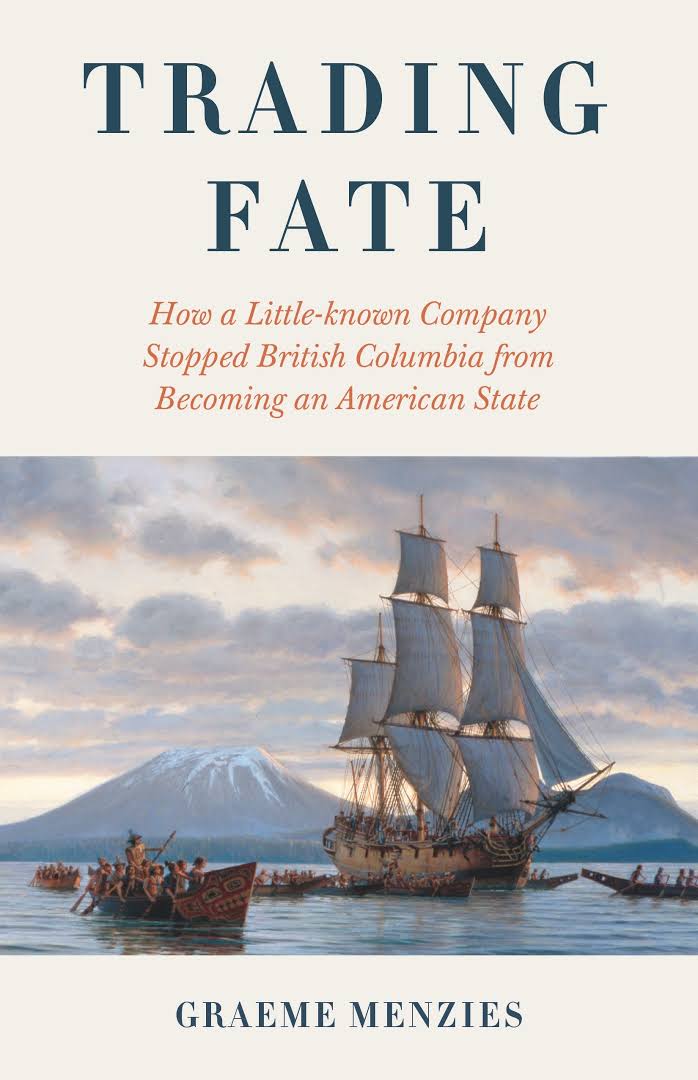
Trading Fate: How a Little-Known Company Stopped British Columbia from Becoming an American State
Review By Jason Colby
July 9, 2026
With Trading Fate, Graeme Menzies sets out to explore the personalities and contingencies that shaped the colonization of the Pacific Coast. In entering such well-trodden territory, he promises something ambitious: to show how the “little-known” King George’s Sound Company (1785–89) prevented British Columbia from “becoming an American state” (page). Considering the company was subsumed more than fifty years before the pivotal events in question, it is a bold claim, and Menzies largely fails to prove it. In fact, he spends little time attending to it. Despite the promise of its subtitle, Trading Fate consists mostly of an engaging narrative of familiar events without a clear argument. Little of the text focuses on the company itself. It is only in the final, counterfactual chapter that Menzies turns to the question at hand. Yet he ultimately fails to show that the events of the 1840s–1870s would have gone differently without the short-lived company, and many of his related assertions strain credulity. His claim, for example, that the 1790 Nootka Conventions “effectively put an end to Spain’s centuries-old claim of exclusive sovereignty over the west coast of America, and marked the beginning of the end of its empire” (90) seems overstated, at best. Likewise, his counterfactual argument that, without the Nootka Crisis, Spain would have built a vibrant empire in the Pacific Northwest seems far-fetched. After all, Spain struggled to channel resources and settlers even to California.
Similar interpretative problems appear frequently, especially in the book’s treatment of the War of 1812. Apparently believing that the principal US objective was northward expansion, Menzies calls the attack on Canada “unprovoked” and “opportunistic” (242). Yet the driving force behind the war was British infringement on American shipping as well as the impressment of US sailors, most infamously the attack on the USS Chesapeake. The United States invaded Canada because it was the only practical way for the nation, which lacked a serviceable navy, to strike at British forces.
Historians will be equally surprised to learn that the war ended with US defeat – apparently when the invasion of Canada was turned back, or perhaps when British troops sacked Washington, DC. In reality, the fighting extended into early 1815, ending with US forces decimating Britain’s Indigenous allies in the Battle of Horseshoe Bend and inflicting a lopsided defeat on a British invading force in the Battle of New Orleans. Menzies seems unaware of these events or the forces behind them. “What exactly drove American expansion westward is hard to say,” he writes. “One reason may be that their attempt to expand northward had failed badly” (173). Yet the westward impulse extended back to the 1760s, at least, and by the 1810s it was the desire for more land for cotton slavery that drove US expansion – Canada was never a priority. Finally, in his engaging discussion of the origins of Confederation and the addition of British Columbia, Menzies misses the real source of pressure from the United States: its post–Civil War claims against Great Britain for the damage inflicted by Confederate ships built in British territory. Before the British government agreed to settle these claims, many Americans demanded Britain’s North American territories as restitution.
Finally, the book’s style and organization could have been stronger. Overall, Menzies is a pleasure to read, but jocular phrases detract from his prose. For example, he describes the 1493 Inter Caetera as having “religious considerations hardwired into the document” (67), and George Vancouver as leading “Team Britain” (77). Likewise, his use of long block quotations disrupts his flow. Finally, readers may find the organization a bit confusing, as Menzies frequently doubles back to earlier periods. For a bit of fun, readers could certainly do worse than Trading Fate. For serious and careful history of the Northwest Coast, however, they could better turn to the works of Barry Gough.
Publication Information
Menzies, Graeme. Trading Fate: How a Little-Known Company Stopped British Columbia from Becoming an American State, Heritage Publishing, 2025. 296 pp. $29.95 paper.