
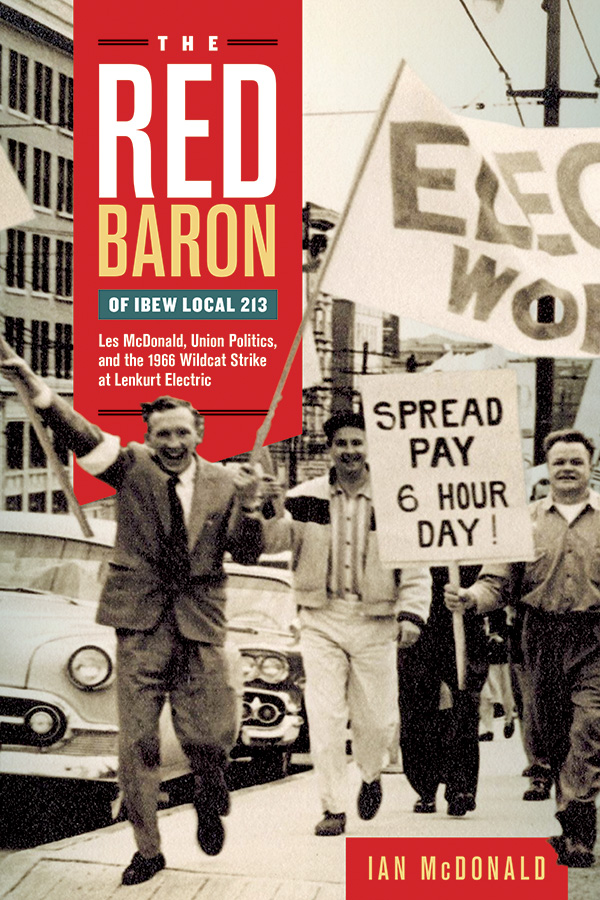
The Red Baron of IBEW Local 213: Les McDonald, Union Politics, and the 1966 Wildcat Strike at Lenkurt Electric
Review By John Henry Harter
July 9, 2026
The Red Baron of IBEW Local 213 examines the politics of a British Columbian union local in the shadow of the Cold War and documents the development of a militant minority within a historically conservative international union, the International Brotherhood of Electrical Workers (IBEW). To understand what went wrong during the 1966 wildcat strike at the Lenkurt Electric plan in Burnaby, British Columbia, the book examines the politics of the province’s union movement in the 1960s, specifically how the members of the Communist Party of Canada navigated IBEW union politics. It documents the life of Les McDonald when he was a communist party member and union activist in British Columbia and also looks at the latter part of his life as an advocate and official in the sport of triathlon.
The Red Baron is not meant to be a survey of labour history, but Ian McDonald does a good job of providing the necessary history for the reader to understand the state of the labour movement leading up to the Lenkurt wildcat. McDonald highlights the union work of Communist Party members in Local 213 in contrast to the business unionism of the IBEW. McDonald identifies the IBEW as a “craft-oriented business union,” which he defines as a union that does not engage in larger class struggle issues but is solely focused on “higher wages, better working conditions, and job security” (16), and explains how the left faction of Local 213 wanted to expand the politics of the IBEW beyond the bread and butter issues of business unionism.
In many ways the heart of the book examines the failure of the Lenkurt strike, which may also indicate some problems in the Communist Party in BC. Most Local 213 members at Lenkurt were women, but the Communist union leaders were men and did not work at the plant. This illustrated a disconnect between the union leadership and the workers as well as a gendered division in union activism and leadership versus the rank and file. It also illustrates a weakness in depth of membership in the CP as “there was no Communist Party presence with the ranks of Lenkurt employees” (138). At every step of the wildcat at Lenkurt, the rank and file seemed ahead of their union leaders and even ahead of the union’s left faction. As Ian McDonald notes, at the end of the day “it was really the workers who were determined and walked out” (143). The organized reaction of capital and the state, with the violent intervention of the RCMP on their behalf, illustrated that when workers moved beyond status quo economics and labour relations to class struggle, the left faction was unprepared.
One of the strengths of The Red Baron is the focus on the local of a union. It offers real insights into the internecine politics on the left and within the labour movement in a way that transcends the time period being discussed. It is through the local that larger issues of factional politics are brought into focus: the role of the Canadian state, the legal obligations of labour leaders to “control” workers’ actions (i.e., prevent walkouts during the life a collective agreement), and how this plays out when the rank and file decide to take matters into their own hands. This focus on individual local stories is a deliberate choice, and The Red Baron offers a close reading of the politics of one local within an international union that allows the reader to see the larger politics of the effects of McCarthyism, the Cold War, and the left/right divide within the labour movement in an intimate and understandable way.
Publication Information
McDonald, Ian. The Red Baron of IBEW Local 213: Les McDonald, Union Politics, and the 1966 Wildcat Strike at Lenkurt Electric. Canadian Committee on Labour History and AU Press, 2026. 358 pp. $39.99 paper.