
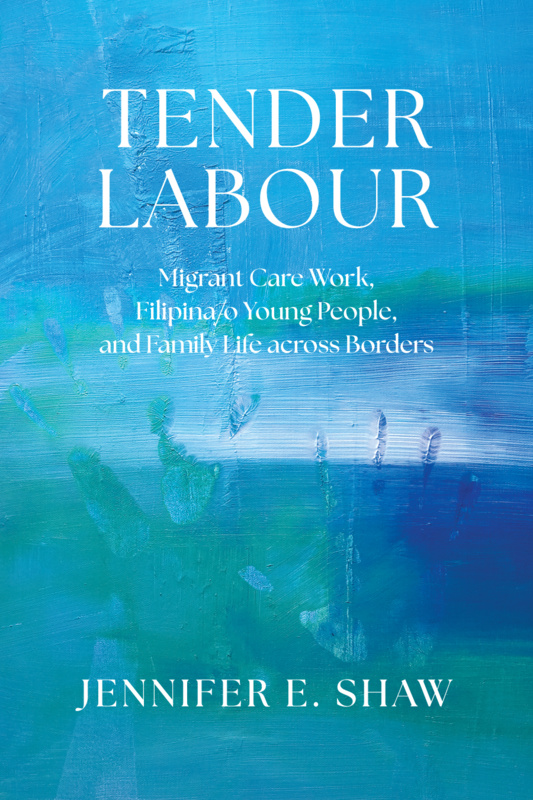
Tender Labour: Migrant Care Work, Filipina/o Young People, and Family Life across Borders
Review By JP Catungal
June 25, 2026
Despite their common designation as under-developed or unknowing subjects, especially in Western contexts, youth and children are “so full of knowledge” (Shaw, 2026, 222). The book Tender Labour, written by Jennifer E. Shaw, ends with this phrase. In so doing, it leaves the reader to linger with and ponder this argument, and challenges us to consider, through detailed engagement with the lives of Filipina/o youth, how they know and act in the world, and especially the worlds they navigate as they are caught up in classed, gendered and racialized regimes of global labour, migration and transnationalism. As the book’s ending, the phrase nicely encapsulates what I think is the main epistemological intervention and political commitment that is at the heart of the author’s astute analysis.
Tender Labour is an ethnographic examination of Filipina/o youth in Greater Vancouver; how they experience precarity intimately as an effect of being caught up in global regimes of labour, migration and transnationalism; and the complex and imperfect ways that they navigate violent dis/locations by tending to their lives and relationships. One of the book’s major strengths is its centering of Filipina/o youths’ perspectives and experiences. Contending with scholarly tendencies to reduce young migrants to passive recipients of the violences of global migration, in Tender Labour,Filipina/o young people’s narratives, experiences and understandings of their lives are elevated into forms of personal and lived analysis. In other words, they are knowledges to be taken seriously, and Shaw does so with precision and, importantly, care. In Tender Labour, Shaw illuminates the ways that Filipina/o young people are insightful theorists of their lives and worlds, their memories and stories articulations (if imperfect and partial) of the larger relational and transnational forces – familial, societal and political economic – that they negotiate in their everyday lives.
Across six main chapters plus the introduction, conclusion and appendix, Shaw beautifully documents the ways that Filipina/o young people labour to make sense of and navigate their social positionings in their everyday lives and through their feelings and bodies. Confusion, anger, ambivalence and disaffection are some of the key embodied and sensorial registers through which these youths register the precarity of their lives. Shaw explores these beautifully across the six chapters, weaving them in with analyses of youths’ willful acts of crafting relations of care with and beyond their nuclear families (especially in chapters 2, 3 and 4); the role of schools and social services in shaping their lives in Canada; and their visions of the good life and futures not just for themselves, but also for their parents, and not just in Canada, but also in the Philippines (Chapter 6 and conclusion). As an anthropologist, Shaw mobilizes a multi-modal approach to ethnography that enables her participant-interlocutors – 10 Filipina/o youth, mostly in their teens – to offer personal narratives and art (particularly creative writing and photography) as ways of sharing their experiences of family separation and how it has impacted their lives and relationships.
The notion of “tender labour” provides an insightful conceptual anchor and a key thread that animates the book’s analysis. It constitutes, I believe, the main theoretical contribution of the book to scholarship on global Filipina/o migration as it intersects especially with critical youth and child studies. A rich concept, “tender labour” is Shaw’s way of making sense of Filipina/o youth participants’ offerings: through skillful analysis, she draws out, for her readers, the multifaceted forms of everyday intersubjective labour that Filipina/o young people undertake not just to understand, but to do something about their familial and relational experiences of precarity resulting from being placed in racialized, classed and gendered global regimes of mobility and migration, within and across national borders and transnational relations. For Shaw, the ‘tend’ in “tender labour” is instructive: it captures the ways that her youth participant-interlocutors work in, on and through their precarious positionings: they attend, in variably complex and sometimes contradictory ways, to relations to parents, siblings, extended relatives, friends and romantic partners amidst lives shaped by dislocations and violence; and they navigate schooling, home lives, and transnational relations with both acute awareness of the difficulties that emerge for migrant and racialized Filipina/o subjects in Canada as well as powerful semblances of hope and purpose that fuel their imaginations for futures that may be elusive but are not necessarily fully impossible.
One very minor quibble that I have with Tender Labour is there is some unevenness with Shaw’s analytical engagement with the youths’ photographs and creative writing, which are included in the book as part of its methodological commitment to multi-modal ethnography. The most thorough analytical engagement, in the Conclusion chapter, is with Vea’s photograph depicting her shadow augmented with butterfly wings that she crafted with art supplies, which is preceded by her own reflection about her various metamorphoses as a migrant subject (194-195). Shaw beautifully writes about how Vea’s creative interventions visualize shifting life courses amidst migration’s dislocations; the dark ‘shadows’ produced by nation-state policies and labour market conditions; and the possibilities of light and flight that index, for her, a future where a good life might exist (196-197). Many other photographs and creative writing excerpts exist throughout the book. Perhaps, in some instances, Shaw left them to speak more for themselves deliberately; indeed, in many ways, they are their own important modes of analysis. As a reader, I wanted more consistent and even-handed integration and deliberate analysis of these creative textual and visual interventions as knowledges offered by the youths themselves.
I come to Tender Labour not just as an interdisciplinary scholar of Filipinx Canadian lives in and beyond BC, but also as a first generation Filipinx Canadian migrant whose family is caught up in the very global regimes of labour migration and transnationalism that are central to the Shaw’s analysis. From both of these personal and academic positions, I am grateful to Jennifer E. Shaw for her contribution to our collective scholarly understanding of Filipina/o/x lives in Canada and transnationally.
Publication Information
Jennifer E. Shaw, Tender Labour: Migrant Care Work, Filipina/o Young People, and Family Life across Borders, UBC Press, 2025. 255 pp. $34.95 paper