
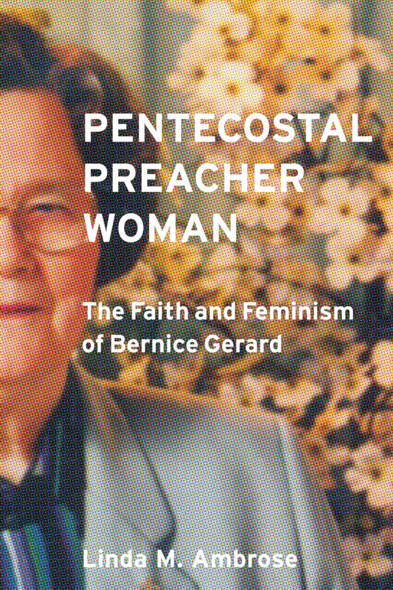
Pentecostal Preacher Woman: The Faith and Feminism of Bernice Gerard
Review By Bruce Douville
August 5, 2025
BC Studies no. 226 Summer 2025 | p. 164-165
In 2000, the Vancouver Sun published a list of the most influential spiritual figures in twentieth-century British Columbia. First on that list was Bernice Gerard (1923-2008), a Vancouver-based pastor, media personality, and city councillor. As Linda Ambrose argues in her biography of Gerard, she was also a complex character: a committed Pentecostal who challenged the patriarchal structures of her denomination; and a professed feminist who challenged the liberal mores of many secular feminists (especially on issues such as sexuality and reproduction). Drawing on sociologists of religion and gender such as Orit Arvishai, Ambrose argues that studying women like Gerard requires readers to set aside their preconceptions about feminism and religion, and pay attention to how these women articulated their own identities, particularly in their life writing. Consequently, Ambrose critically examines Bernice Gerard’s two published autobiographies (from 1956 and 1988) as well as other examples of self-narration including her sermons and radio addresses, to demonstrate “that Gerard practiced self-authoring on many topics, to make meaning from the complexities she embodied” (14).
The result is a compelling exploration of Gerard’s multifaceted life: her childhood with her adoptive family (including an abusive adoptive father); her youth in a series of foster homes; her conversion in the 1930s to fundamentalist Christianity and, shortly thereafter, to Pentecostalism with its emphasis on “Spirit baptism” and speaking in tongues; her evangelistic career with sisters Jean and Velma McColl, as the trio travelled across North America, Latin America and Europe in the 1940s and 1950s; her return to Vancouver where she ministered as a university chaplain, co-pastored a church with Velma McColl, and hosted a popular radio call-in show; and her brief, notorious career as an alderman with the city of Vancouver, in which she championed moralistic causes such as curbing the spread of nudity on the city’s public beaches.
Ambrose highlights the importance of gender in Gerard’s life experiences and how Gerard narrated them. This was particularly true of her identity as a Pentecostal minister. Historically, North American Pentecostals had been more open than other evangelical Christians to women’s leadership, but with the establishment of denominations such as the Pentecostal Assemblies of Canada (PAOC), institutional patriarchy became the norm. Although Gerard and Velma McColl functioned as pastors in the PAOC, their ordination credentials were through the Assemblies of God (an American Pentecostal denomination) because the Canadian church did not formally approve the ordination of women until the 1980s. Gerard waged an ongoing battle against patriarchy in her own denomination, and as Ambrose shows in her examination of Gerard’s published memoirs, sermons, and media statements, Gerard justified her feminist position not only on the basis of her own decades of lived experience as a female minister, but also drew on the writings of Christian feminist theologians and even secular feminists such as Germaine Greer (186).
Readers interested specifically in the social, cultural and political history of twentieth-century British Columbia will find much of interest in this book: about the province’s child welfare system in the 1930s and 1940s; about the vitality of Pentecostalism and charismatic evangelical Christianity in the province (and across Canada) throughout the twentieth century; and about the political strength of faith-based social conservatism in a province reputed for irreligion, liberal social mores, and left-wing politics. More broadly, Ambrose’s biographical study of Gerard is a window into global Pentecostalism in the twentieth century, as Gerard and the McColl sisters had established connections with like-minded believers across the world in the 1940s and 1950s, and Gerard built on these connections in her subsequent decades of ministry in Vancouver.
Pentecostal Preacher Woman is an engaging, readable book – well organized and generously supplemented with well-chosen pictures. It is carefully crafted from the author’s extensive archival research and demonstrates a wide knowledge of relevant secondary literature. Moreover, while Ambrose treats her subject sympathetically, she has nonetheless authored a critical and contextual study, with useful insights into Gerard’s motives and psychological makeup. This work is a valuable scholarly contribution to the fields of Canadian religious history and Canadian women’s history.
Publication Information
Ambrose, Linda, Pentecostal Preacher Woman: The Faith and Feminism of Bernice Gerard. Vancouver: UBC Press, 2024. 320 pp. $37.95 paper.