
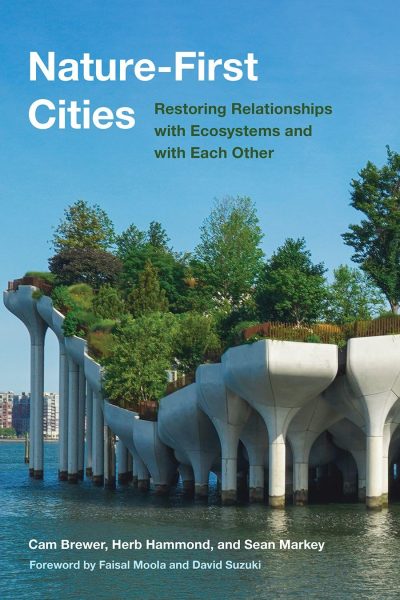
Nature-First Cities: Restoring Relationships with Ecosystems and with Each Other
Review By Paul Stangl
November 18, 2025
BC Studies no. 227 Autumn 2025 | p. 194-196
The natural environment permeates the city in myriad ways, yet we tend to think of them as separate entities. Nature-First Cities breaks significant ground, pointing out that the city-nature nature dichotomy is a false one and offering a strategic approach to radically transform cities to optimize the best of both the urban and natural worlds. In this sense, the book updates Ebenezer Howards’ Town-Country for the twenty-first century.
The book examines how our dominant city building traditions have sought to suppress and subjugate nature to the detriment of both urban residents and the non-human world. The authors review considerable evidence that this approach to urban nature is expensive and harmfully affects the physical and mental health of urban residents, particularly those in low-income areas. Long-running efforts by reformers and city planners to better incorporate nature into cities are portrayed as a small step in the right direction. The authors’ ambitious goal is the wholesale reshaping of cities to restore ecosystems. Careful design will allow for medium to high urban densities while erasing any sharp distinction between nature and the city. New green spaces, as focal points for planning efforts and recreational activities, will also facilitate social interaction and community building.
Their solution is Nature Directed Stewardship (NDS), which was developed by one of the authors to protect forest ecosystems threatened by resource extraction. Transferring this to metropolitan areas means putting “nature first in cities, creating … nature-first cities.” The boundaries of planning efforts will no longer be those of the municipality or the metropolitan area, but a target watershed. The long-term goal is to restore “ecological integrity, wild biodiversity, and ecosystems” throughout the city, with the pre-settlement conditions as a target. The authors recognize the immensity of this task, assigning a planning horizon of 250-500 years or more. They propose working in a stepwise manner with a broad range of participants, including residents, government agencies, scientists and indigenous knowledge holders. To balance urbanity with nature, they propose the addition of green roofs, green walls, reclaiming minor roads and alleys, raingardens and bioswales and multi-layered vegetation, along with daylighting streams and lining them with planted areas. The resulting network could eliminate flooding and greatly reduce water pollution by restoring the hydrological cycles. It also restores vegetation throughout the city, reduces air pollution, and reinvites wildlife to the city though well-connected habitats.
A range of case studies from cities around the world demonstrate effective efforts to improve natural conditions in cities. The authors’ more ambitious goal is illustrated with a case study on the application of NDS to restore the Still Creek watershed in East Vancouver. Once a “sea of green and blue veins and arteries of water connecting the complex biological diversity of a temperate rainforest,” the area has undergone successive eras of development culminating in a bland, rather suburban sea of concrete and buildings. The authors describe this as an “ecologically impoverished watershed,” lacking vegetation and wildlife, while facilitating water pollution and enhanced temperature swings. The restoration plan builds upon preserved fragments of nature and creates linkages to restore water movement and rebuild ecosystems with design solutions tailored to different land uses. This case study provides a clear image of the successful application of NDS in terms of physical planning and community involvement. Even the chum salmon concur, returning to spawn after an eighty-year absence.
Nature-First Cities is to be commended for challenging the city-nature dichotomy and demonstrating how urban areas can welcome nature for the benefit of city residents and the surrounding environment. However, the grand scale of this issue raises many questions. The authors make a forceful claim for the expansive restoration of nature in cities and cite many benefits but could go much further in examining negative consequences. In what ways does the widespread introduction of vegetation and wildlife into cities result in damage to buildings and conflict with human activities? How would the design approaches for NDS be altered for different climates? While NDS greatly improved a suburban area in the case study, would it be suitable for dense, vital urban centers or result in their dissolution? Debates between modernist and traditionalist architects and city planners can shed light on this issue. What would result if professionals from different fields developed their own approaches to balancing nature and cities? One could imagine books written by different combinations of specialists. An urban historian, environmental engineer and urban sociologist most likely would have a very different vision than a landscape historian, architect and urban economist. This topic is too large and complex for a definitive solution, but efforts such as Nature First Cities provide much needed, thoughtful guides for approaching the nature-city relationship.
Publication Information
Brewer, Cam, Herb Hammond, and Sean Markey. Nature-First Cities: Restoring Relationships with Ecosystems and with Each Other. Vancouver: University of British Columbia Press, 2024. 258pp. $39.95 paperback.