Mountain Voices: The Mountain Legacy Project and a Century of Change in Western Canada
Review By Joseph E. Taylor III
June 25, 2026
I have been party to enough multi-authored anthologies to know editing a collection is a thankless task. Herding cats is more efficient, chewing foil more pleasurable. Reading Mountain Voices reminds me of this because its title, structure, and imagery are compelling, but the essays often lose the trail. The best bits focus on a re-photography project documenting rapid changes in Canada’s western ranges. The least vital parts dwell on personal experiences in the mountains, fully ignoring the accompanying imagery; the worst is a 562-word entry that deploys the first-person singular or plural thirty-seven times. It’s not clear whether the editors intended this or lost control; either way, it feels like an extraordinary story partially escaped their grasp.
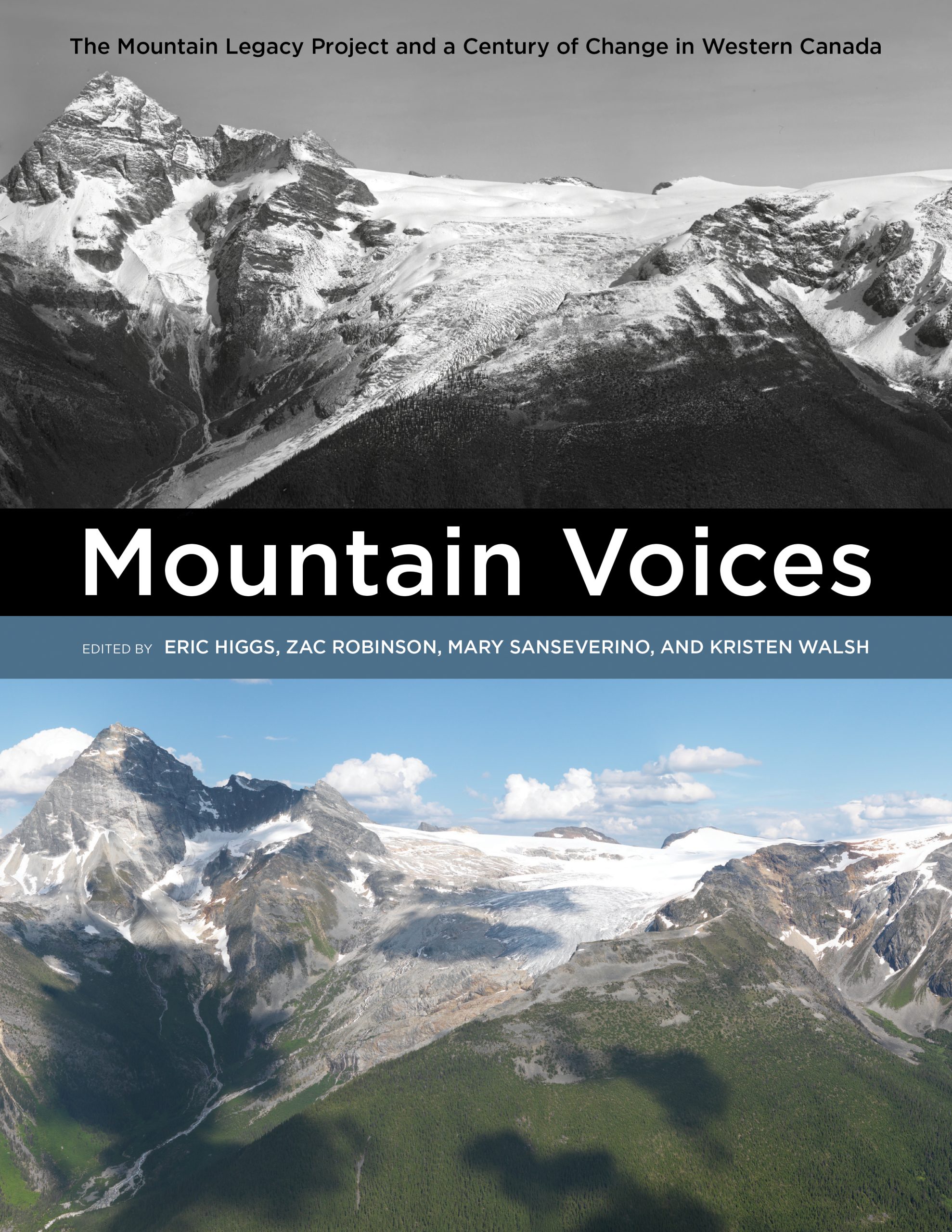
The fulcrum for Mountain Voices was the accidental discovery of a phenomenal cache of glass plates from the Topographical Surveys Branch of Canada’s Department of Interior. The plates bore breathtaking mountain panoramas. Their creation, however, was not for aesthetics but a technological shortcut to surveying mountainous terrain without tripods, theodolites, chains, and crews. The dusty plates have lately been repurposed for an ambitious re-photography expedition called the Mountain Legacy Project. The goal is to reproduce the exact same images to document environmental change across more than a century of time.
The editors begin by recounting the history of the original surveys, the novel techniques, and the ongoing re-photography project. This is a fascinating tale, and the rest of the book’s fifty short essays—each about 600 words—focus on portions of those ranges. Each piece is literally framed by before-and-after imagery. The authors were supposed to “respond to the paired photographs” (x). Some do, including Rick Arthur, Jill Delaney, Julie Forth, Gúdia Johnson, David Jones, Roger Laurilla, Liza Piper, Chris Rhodes, Mary Sanseverino, Rob Watt, and Carmen Wong. These pieces engage the textual substance of the photos, analyzing ecological and social changes wrought by melting ice, raging fire, and resettlement. The subtext is climate change, the insights chastening. A second group of authors, including Johnson, Reneltta Arluk, Winston Louis Delorme, Paulette Fox, and William Snow, offer indigenous reads of the imagery. These pieces vitally excavate additional social and cultural dimensions.
Thereafter things go awry. A few chapters pair photos which defy analytical comparison. Many authors go off-route. They turn inward. We get highly personal accounts, usually long on self-discovery and short on revelation. These essays read as white people talking about white mountains as white spaces: capital-N Nature, the sublime, adventure, solitude, so on. It is like they were writing a different book, or, more harshly but likely, they were not interested in the editors’ book. Like most nature writing since Thoreau, the essays are mainly about the authors.
But here’s the catch: the most daring and exceptional piece is by Rain Scott. Scott relays a different kind of adventure, one exponentially braver than any other climbing story I have read. Through their own climbing experiences, Scott pulls apart mountaineering’s racial, gendered, and sexed norms by recounting how they have to mask among strangers. It took years to find a cohort in which “people could ask for help and be vulnerable,” and “where the scariest thing happening is the mountain you are climbing, not the people you are with” (140). It is difficult to overstate the problem. Mountaineering culture still reflects the values of the starched Victorians who invented the sport: chaps and women such as Leslie Stephen, John Tyndall, Lucy Walker, and Alfred Will, the latter of whom condemned Oscar Wilde to two years hard labor for the love that dare not speak its name. These bigotries still haunt camp fires around the world. Scott’s essay, the pieces by indigenous authors, and the analyses by the editors and writers who actually engage the re-photography project are worth the read. The rest is more of the standard drivel that has long inflated climbing and environmental literature.
Publication Information
Eric Higgs, Zac Robinson, Mary Sanseverino, and Kristen Walsh, Mountain Voices: The Mountain Legacy Project and a Century of Change in Western Canada, University of Calgary Press, 2025. 164 pp. $44.99 paper.