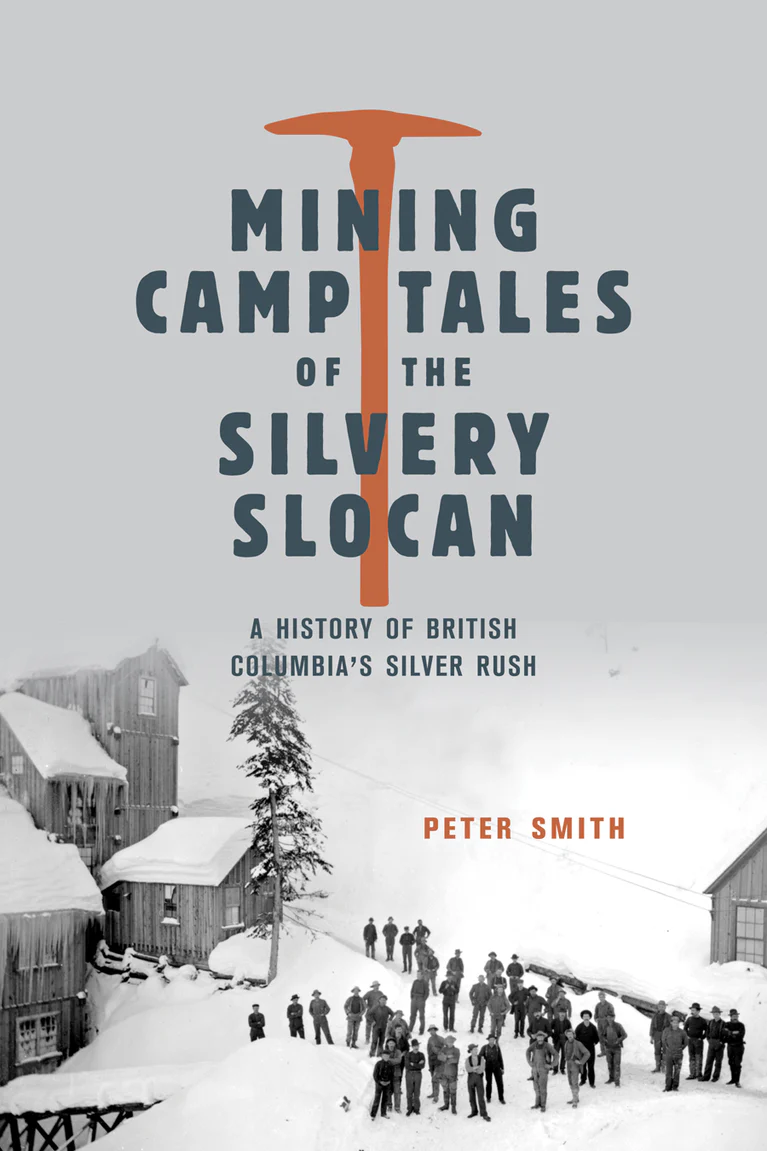
Mining Camp Tales of the Silvery Slocan: A History of British Columbia’s Silver Rush
Review By Arn Keeling
September 9, 2025
BC Studies no. 227 Autumn 2025 | p. 203-204
Building on his previous book Silver Rush, Peter Smith presents a comprehensive, even encyclopedic account of the history of the Slocan district sliver rush of the 1890s. Combining detailed and wide-ranging documentation of the rush’s key figures and events with rollicking “mining camp tales,” this volume is likely to appeal to historians interested in BC’s mining frontier settlement as well as more casual mining history enthusiasts.
In just a few short years, the rush for silver in the West Kootenay transformed this mountainous, sparsely settled region. Like so many frontier mineral rushes, it sparked mass non-Indigenous in-migration, the creation of new settlements, and wild economic speculation, before almost as quickly collapsing. The Slocan silver boom, roughly between 1891 and 1900, traced this familiar arc, leaving behind small contemporary post-mining towns and the celebrated “ghost town” of Sandon, once the region’s “urban oasis.”
Drawing on extensive source work in historical newspapers, local histories, and archival sources, Smith recounts the origins, boom times, and bust(s) of this period with flair. While focusing on the major personalities of the region, from prospector Eli Carpenter to the controversial “king” of Sandon, Johnny Harris, the book also tracks the experiences of lesser-known Slocan figures from packers to prostitutes to hoteliers. While not quite a “social history” study in the scholarly sense, Smith’s account does include broadly social concerns often omitted from many popular and celebratory mining histories, including the impacts of the invasion of miners on the Sinixt and Ktunaxa peoples, the violent racism directed at Chinese workers, and the role of women in the mining towns of Kaslo, New Denver, and Sandon. Mine workers, too, get their due, as later chapters explore the dangers associated with underground mining and the advent of unionism in the Slocan in the late 1890s.
Another strength of the book is to place the Slocan boom and bust in the context of BC’s frontier history and mining history more broadly. Relatively remote from BC and Canadian centres of power and population, the Slocan retained a resolutely American character for much of this period, influencing everything from local politics to sporting preferences (baseball, rather than lacrosse). The flows of capital and labour ran significantly north-south, although as the district became established, London investors played a greater role. Smith’s account also shows how the decline of silver mining in the Slocan was tied to the mania for gold sparked by discoveries both near (Rossland) and far (the Klondike), as well as the waning fortunes (and prices) for silver itself.
As reflected in the scores of names in the book’s index, Mining Camp Tales presents an extremely detailed, panoramic account of this colourful period in the history of this remote (and beautiful) part of the province. If at times difficult to discern in the blizzard of names and stories, it also offers insight into the importance of the Slocan rush to BC’s settlement history, and will remain a useful reference for students of the period’s social and economic history.
Publication Information
Smith, Peter. Mining Camp Tales of the Silvery Slocan: A History of British Columbia’s Silver Rush. Victoria: Heritage House Publishing, 2025. 379pp. $ 34.95 paper.