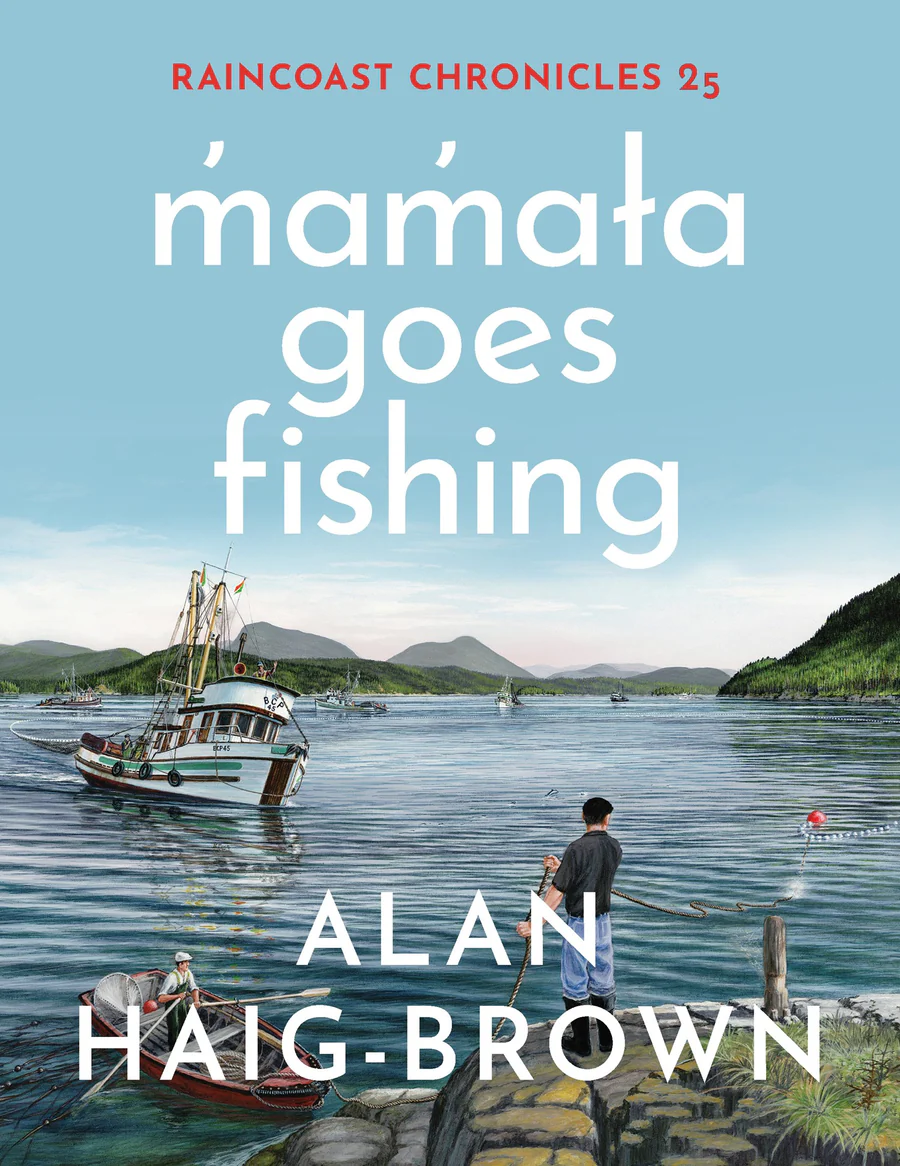
m̓am̓aɫa Goes Fishing
Review By Stephen Ross
October 9, 2025
BC Studies no. 227 Autumn 2025 | p. 197-198
Alan Haig-Brown’s m̓am̓aɫa Goes Fishing is a nostalgic look at the semi-independent fishery of the 1960s and into the 1970s, especially in the waters of Johnstone Strait. Haig-Brown had a privileged perspective on this time, place, and set of practices by virtue of marrying into the family of Herb Assu, one of the last semi-independent Indigenous fishers plying those waters. As a white settler – m̓am̓aɫa means “white man” – Haig-Brown got to see the hard work that Indigenous fishers put into sustaining the province’s thriving salmon and herring fisheries. He also saw the racist and inequitable practices by which ever-larger corporate fishing entities controlled fishers and gradually pushed them out of business. Across its pages, m̓am̓aɫa Goes Fishing traces this process while indulging in soft-focus nostalgia about huge meals prepared in a tiny galley by Herb Assu’s wife Mitzi, some perilous journeys, and a semi-mythologized account of Assu’s skills.
m̓am̓aɫa Goes Fishing is really three stories, then. First, it’s a personal memoir that follows Haig-Brown from dropping out of high school to find work to marrying into the Assu family, labouring on Herb’s boats, a stint living on a boat in False Creek, and his emergence as a prominent writer. Second, it tells the tale of the Assu family’s long-standing role as fishers in coastal waters, invoking their ancestral practices and documenting how debt-finance and technological advances first made their approach obsolete and then forced them to sell the family fishing license to escape bankruptcy. Third, m̓am̓aɫa Goes Fishing chronicles the larger changes in the Pacific salmon fishery during those crucial years, tracking the influx of European fishers, the trend towards ever-larger boats, ever-more-efficient machinery, and ever-more-aggressive fishing methods in the race to make a buck. This is the true bass note that sustains the book: the transition from forms of fishing that were anchored in stewardship towards cold-blooded exploitation of salmon and herring as simple commodities. Accompanying this note is a leitmotif that condemns the shift away from careful Indigenous practices to a mode of capitalist settler exploitation underwritten by racism, the profit motive, and market consolidation.
It’s a book from which I learned a lot, and on that basis alone I recommend it. I fish some of the same waters myself, and it’s fascinating to read about how seiners from an earlier time flirted with shorelines to anchor nets to trees and rocks while setting nets out into the current. I can only imagine the nerve and skill it must have taken to do that without at least ending up in the drink once in a while, if not outright killed by a snapping line or simple mis-step on the slippery shore. Haig-Brown brings these practices home with plain language that conveys the matter-of-fact attitude those working on the boats must have had to adopt even as it dares us to imagine the smells, movements, and dangers.
If I have one qualm about m̓am̓aɫa Goes Fishing it’s how Haig-Brown leans rather too heavily on the trope of the strong, silent, knowing Indigenous man. Herb Assu may well have been the strong silent type, but Haig-Brown’s tendency to attribute Assu’s knowledge and ability to racial memory is troubling. Why must Assu’s intimate knowledge of the waterways and coastlines be a product of his Indigenous identity rather than a lifetime of close study and memory? Mythologizing Assu as Haig-Brown does undermines Assu’s abilities by naturalizing them: he is born with them rather than acquiring them. The portrait of Assu’s grim, silent, authority contributes to this romanticism and, I think, detracts from the respect Haig-Brown urges us to feel for Assu.
That said, m̓am̓aɫa Goes Fishing is a hugely valuable read. It illuminates the day-to-day life of a bygone era in the salmon and herring fisheries of the Johnstone Strait and situates them in the larger contexts of creeping capitalism and ongoing dispossession of Indigenous people trying against the odds to maintain their traditional practices. The book’s ending is infuriating. And that’s as it should be.
Publication Information
Haig-Brown, Alan. m̓am̓aɫa Goes Fishing. Madeira Park: Harbour Publishing, 2025. 112 pp. $ 24.95 paper.