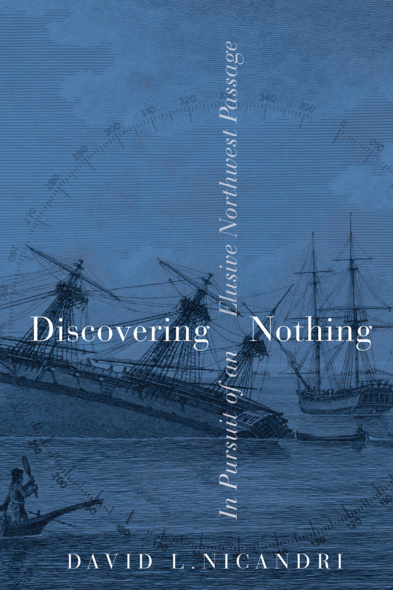
Discovering Nothing: In Pursuit of an Elusive Northwest Passage
Review By Sean Fraga
August 5, 2025
BC Studies no. 226 Summer 2025 | p. 156-157
There never was a Northwest Passage. For centuries after Christopher Columbus encountered the Americas while seeking a new route to Asia, Europeans fruitlessly searched North America’s Atlantic Coast for an entrance to the Northwest Passage, imagined as a water route to the Pacific Ocean. David Nicandri recounts how, starting in the 1770s, a series of British and American expeditions sought the Northwest Passage from the Pacific Coast. His title — Discovering Nothing — neatly summarizes these expeditions’ repeated outcomes.
Nicandri presents a careful examination of a multiple expeditions. His study is transnational — covering British, American, and Canadian projects — and terraqueous, including both terrestrial and maritime expeditions. The book’s primary argument, Nicandri writes, is that “there was actually a series of Northwest Passages,” (xix, emphasis original). Explorers variously imagined the passage as an all-water route between the oceans, a series of easy portages between inland seas, or a skein of connecting rivers threading. “The idea of a shortcut between the two oceans was so durable and compelling,” he writes, “that when one version failed to materialize another was proffered” (xix). Nicandri’s framing usefully recovers the complexity of nineteenth-century geographic thought by emphasizing that the Northwest Passage was an idea, not a physical route.
Nicandri organizes his study into a substantial prologue and 12 chapters. Because these chapters overlap in chronology — Northwest Passage exploration being a crowded field — Nicandri includes a helpful timeline as an appendix. He takes Captain James Cook’s third Pacific voyage (1776–80) as the book’s departure point. The prologue and first three chapters cover terrestrial explorers of the North American West (John Ledyard, Peter Pond, Alexander Mackenzie) and show the fur trade as a driving force for expansion of British geographic knowledge. Chapters four through seven take us into the water, first with another fur trader, John Meares, and then with Captain George Vancouver, who sailed in Cook’s wake. Chapter eight examines the Lewis and Clark Expedition (1804–06) as American overland exploration in search of the passage.
We then jump ahead to the 1850s, to a world reshaped by steam power. “A practicable Northwest Passage was never discovered,” Nicandri writes, “but one was eventually built in the industrial form of the transcontinental railroad” (xxvi, emphasis original). Chapter nine describes the U.S. Pacific Railroad Surveys party led by Isaac Stevens to Puget Sound (1853–55); chapter ten narrates Canadian Pacific Railway construction. Chapter eleven summarizes Arctic expeditions, and an epilogue briefly considers the Northwest Passage today, when global warming is creating a regular ice-free corridor across the top of the world.
Nicandri keeps close to the act of exploration — rivers ascended, mountains crossed, coasts charted — which enables him to showcase the frequent slippages between explorers’ geographic beliefs and the actual geography they encountered. But in sticking so near to explorers’ accounts, Nicandri spends little time on how these accounts were popularly received, and less on why all these expeditions mattered.
Indeed, readers unfamiliar with the Northwest Passage might wonder why all these explorers spent so much time and effort searching for a non-existent link between the oceans. Nicandri, who has written extensively on Euro-American exploration of the Pacific Northwest, briefly mentions “the long tradition of the Northwest Passage ideal as the shortcut to Asia” (xviii). A fuller explanation of this history would have better prepared readers to follow Nicandri’s narrative.
Discovering Nothing demonstrates the Northwest Passage’s powerful pull and will be of interest to scholars of exploration, geography, and empire. A deeper engagement with the meanings these expeditions held at the time — and their legacies today — could have transformed an impressive narrative into a more provocative history of imperial ambition.
Publication Information
Nicandri, David L. Discovering Nothing: In Pursuit of an Elusive Northwest Passage. Vancouver: UBC Press, 2024. 322 pp. $37.95 paper.