
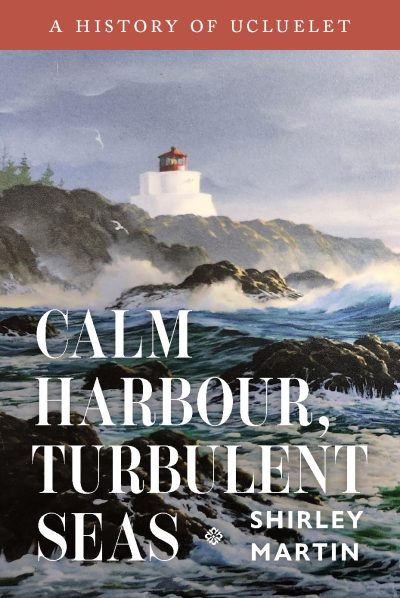
Calm Harbour, Turbulent Seas: A History of Ucluelet
Review By Jason M. Colby
February 19, 2026
Recent years have brought a spate of works about local history by BC authors. In that spirit, Shirley Martin presents Calm Harbour, Turbulent Seas – a historical portrait of her hometown of Ucluelet. Her account opens with a lovely vignette of a kayak excursion that connects local places to the history she is about to tell. “Close to the head of the harbour,” she writes, “I float and gaze at what was once the site of the logging camp where I spent my early childhood” (xi). “I loved it all,” she continues, “but never reflected on what forged the landscape of this place I call home” (1). It is an evocative opening to a book that doesn’t deliver the critical and cohesive history it seems to promise.
The main problem with Calm Harbour, Turbulent Seas lies in its organization. Martin structures her book thematically, which undermines its narrative flow. After an extremely short chapter on the natural history of Ucluelet, and another on its Indigenous history (the latter less than three and a half pages), she devotes the remaining pages to the period following European contact. Compelled by her organizational choices, she shoehorns events from late eighteenth-century contact to the forced assimilation and Indigeous revitalization of the twentieth century into the following chapter, “Arrival of the Uninvited.” In the process, she offers the obligatory critiques of European newcomers, asserting, for example, that “the new arrivals came with a history of depleting the environment” (12). Of course, such an observation would be equally true of human societies everywhere, including the First Nations. Likewise, in a quick discussion of dispossession, she declares that “colonialism was rampant, with settlers taking land under the umbrella of the Canadian government” – though she never defines “colonialism” (12). Another chapter, “Of Whales and Whaling,” takes the reader from precontact Indigenous whaling cultures through to twentieth-first century whale watching. In addition to telescoping diverse and disconnected historical events into one chapter, Martin seems unfamiliar with the key historical works on the topic, including Charlotte Coté’s Spirits of Our Whaling Ancestors (2010) and Joshua Reid’s The Sea Is My Country (2015).
Thematic organization is tempting for writers trying to assemble a vast amount of material, but it rarely works for local history. In the case of Calm Harbour, Turbulent Seas, the result is not only chronological whiplash but a failure to connect historical developments over time. It makes little sense, for example, to offer a discussion of residential schools prior to a chapter entitled “Spreading the Gospel.” As a result, rather than a work of history, the book resembles a walking tour, peppered with personal vignettes and biographical sketches.
At the heart of it all lies an unexplored tension inherent in much local BC historical writing. On the one hand, authors express a generalized criticism and even guilt toward the history of conquest and colonialism that shaped the region. On the other hand, they offer nostalgic portraits of the communities that such processes made possible. In this spirit, one can almost feel Martin trying to reconcile the injustice of colonialism with her affection for her community and the people who made it. In her chapter “More Settlers Arrive,” for example, she lovingly narrates the stories of several families who made homes in Ucluelet, in the process making no effort to connect colonial dispossession to the settler opportunities it made possible. The book likewise makes no attempt to untangle the questions surrounding Japanese Canadians as both settlers benefiting from colonialism and as victims of the racist actions of the Canadian state.
Such observations intend no specific criticism of Martin: very few writers have explored such tension. But it underscores that, in contrast to Coll Thrush’s Wrecked (2025), for example, Calm Harbour, Turbulent Seas is not a book aiming to reframe historical understanding. It is, rather, a kind and personal portrait of a little town on the edge of the world’s great ocean. Martin may not approach her material as a professional historian, but she is a thoughtful guide to a place she knows and loves. Although not suitable for classroom use, her book will appeal to locals as well as tourists interested in the history of the outer coast.
Publication Information
Martin, Shirley. Calm Harbour, Turbulent Seas: A History of Ucluelet. Madeira Park, BC: Harbour Publishing, 2025. 448 pp. Hardcover.