Anti-Asian Racism and the COVID-19 Pandemic in Canada
Review By Elic Chan
June 25, 2026
As the SARS-CoV-2 virus was spreading around the globe in the early months of 2020, a parallel “shadow pandemic” emerged across Canada. From the physical streets of Vancouver’s Chinatown to the digital threads on social media, Asian Canadians were subjected to a resurgence of xenophobia. Anti-Asian Racism and the COVID-19 Pandemic in Canada captures the events and critical analysis of this crisis. A collaborative effort from a multidisciplinary team, this edited volume argues that this was not a unique phenomenon, but rather a modern version of Canada’s foundational yellow peril narrative.
The book dissects the anatomy of the pandemic through three sections: 1) History and Geopolitics of Anti-Asian Fear, 2) Anti-Asian Racism in the Media, and 3) Lived Experiences. The first section presents an overview of legacies and institutional forces that provide the backdrop for contemporary racism. These include the discourse of foreign disease and endangered whiteness (chapter 1), Chinatown as site of trauma and resistance (chapter 2), the impact of international relations on local group relations (chapter 3) and construction of pan-ethnic identity among subethnic groups (chapter 4).
The first section traces contemporary anti-Asian hostility to nineteenth-century narratives that framed Asian bodies as sources of disease and threat. Although similar observations were made in Carrianne Leung’s work on the SARS epidemic in 2008, by grounding contemporary incidents during COVID-19 in the lineage of maltreatment towards Asian Canadians (such as the head tax and the 1907 anti-Oriental riots), the project unapologetically challenges the myth of multicultural exceptionalism and harmony.
The second section shifts to the role of media and discourse. This includes comparative anti-China news coverage (chapter 5), the Bryan Adams Twitter controversy (chapter 6), and online activism against racism (chapter 7). The analysis of the Bryan Adams bat eating controversy will stand the test of time, but the book’s most innovative contribution is the chapter on online ethnic mobilization. The study demonstrates how Asians in Quebec utilized digital platforms to mobilize against hate and to provide a support system for one another. While traditional research on minority social movements often prioritizes physical activism, this section modernizes the understanding of minority resistance through the digital lens. This is an underexplored area in Canadian scholarship.
The final section focuses on the lived experiences during the pandemic. This section shows how the pandemic disproportionately impacted workers (chapter 8), young adults (chapter 9), and minority students (chapter 10). These chapters move beyond the analysis of systems to micro-level hyper-vigilance and the “burden of representation” experiences. This section adds to the existing literature on the minority struggle during the pandemic, supplementing the existing quantitative studies on discrimination and hate crime.
Overall, this volume is a reminder that while the virus may have receded into the background, the everyday racism it revitalized requires greater awareness and sustained intervention. This volume is an essential addition to the scholarship of Canadian sociology, history, ethnic studies, media, and community health. Each section can easily be adapted into the curricula of specific disciplines without adopting the whole book. At the same time, as with most edited volumes, it lacks a new holistic theoretical lens on how to move beyond the current understanding of racism in Canada.
Another drawback, particularly in the British Columbia context, is that the content focuses heavily on Eastern Canada. The lived experiences are mostly drawn from east of Saskatoon – reflecting very little of the West Coast experience. Henry Yu is the only contributor from British Columbia and is not a research chapter contributor. However, his ceremonial conclusion discussing the infamous Dakota Holmes incident along with his enduring fight to help Canadians “unlearn” our “mistaken past” is uplifting. Nonetheless, this collection is not only a record of a dark chapter in Canadian history but a call for the next generation to dismantle the discrimination that continues to contradict Canada’s commitment to multiculturalism.
Publication Information
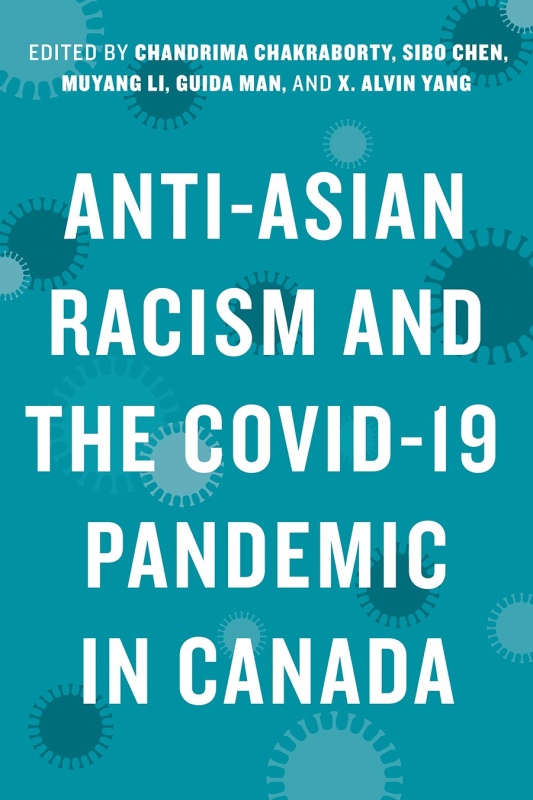
Anti-Asian Racism and the COVID-19 Pandemic in Canada, edited by Chandrima Chakraborty, Sibo Chen, Muyang Li, Guida Man, and X. Alvin Yang
UBC Press, 2026. 282 pp. $37.95 paper.