Alternative Schools in British Columbia 1960-1975: A Social and Cultural History
Review By Nancy Janovicek
February 26, 2026
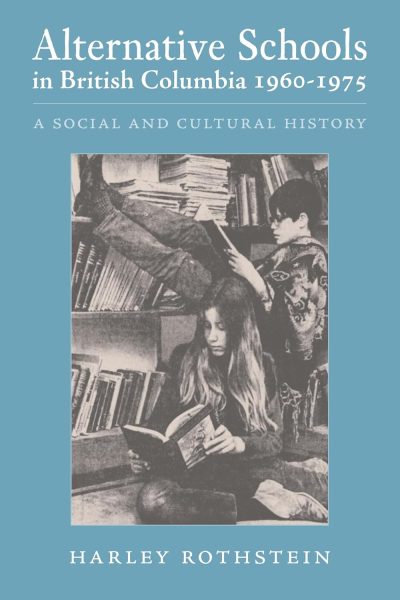
Alternative Schools in British Columbia is a comprehensive history of experiments in alternative education in British Columbia that began in the 1960s. Rothstein’s argument is that this decade was “a unique period of idealism, experimentation, and activism” (3) that fostered a movement to promote child-centred education. This was a parent-led movement opposed to rigid curriculum that, in the 1950s, emphasized scientific subjects to promote technocratic solutions to problems over holistic humanistic education. Rothstein admires the gumption of the parents who gave time and resources to create and sustain these schools, but he also provides a critical analysis of the limitations of idealistic experiments that were not based in educational theory.
The book is based on his doctoral dissertation completed over twenty years go. Since then, he has conducted more interviews with teachers, parents, and students (350 in total), which offers time for reflections on the strengths and limitations of alternative forms of education. Although these schools followed the countercultural values of the 1960s, they were also inspired by John Dewey’s early twentieth-century progressive education philosophy and the Summerhill School founded in Suffolk in 1927. They were local initiatives that reflected the values of the parents who founded them, but they were not isolated experiments. This Magazine is about Schools, published from 1966 to 1976, was a forum where advocates of alternative schools could exchange ideas, debate pedagogical practices, and build a movement to encourage broader educational reform in Canada and the United States. This movement advocating for child-centred education had an impact on mainstream education, which is one of the reasons for the decline in popularity of alternative schools in the mid-1970s.
Rothstein identifies four types of experimental schools: 1) progressive schools that supported child-centred education; 2) romantic or free schools that emphasized student-led exploration; 3) therapeutic schools developed for teenagers at risk of dropping out of school; and 4) public alternative schools and programs initiated by a 1967 British Columbia Teachers Federation report that introduced new philosophies on individualized humanistic education into the public school system. The book includes eleven in-depth case studies of alternative schools in both urban and rural communities. The back-to-the-land movement in BC accounts for the popularity of alternative schools in rural areas. He examines school philosophies, governance, and curriculum and the often-intense disagreements among school founders about how to best educate children. Indeed, parental disagreement is one of the reasons for the closure of many of these schools. Conflicts about governance and curriculum were exacerbated by financial instability, which was sometimes precarious because of low tuition fees that reflected the value of making education accessible to all. Economic precarity also made it difficult to secure adequate resources to support children with disabilities. In many schools, parents volunteered to teach, but wages for teachers were low because of inadequate funding, but also because parents expected paid staff to buy-in to their values and provide their labour to the movement. Without a cohesive vision for the schools and guided by loose governance structures designed to flatten hierarchical power structures, most of these schools could not work through disputes.
Debates about education have always reflected the politics of the time. Alternative Schools examines parental activism for education that encouraged self-expression and critical engagement with the world. I’m writing this book review in a province where the government has passed legislation to advance parental rights initiatives that seek to supress the right of some students to be their authentic selves. Reading this book is a good reminder of why students must be at the centre of educational reform.
Publication Information
Rothstein, Harley. Alternative Schools in British Columbia 1960-1975: A Social and Cultural History. Altona: Freison Press, 2024. pp. 660. $41.99 paper.