
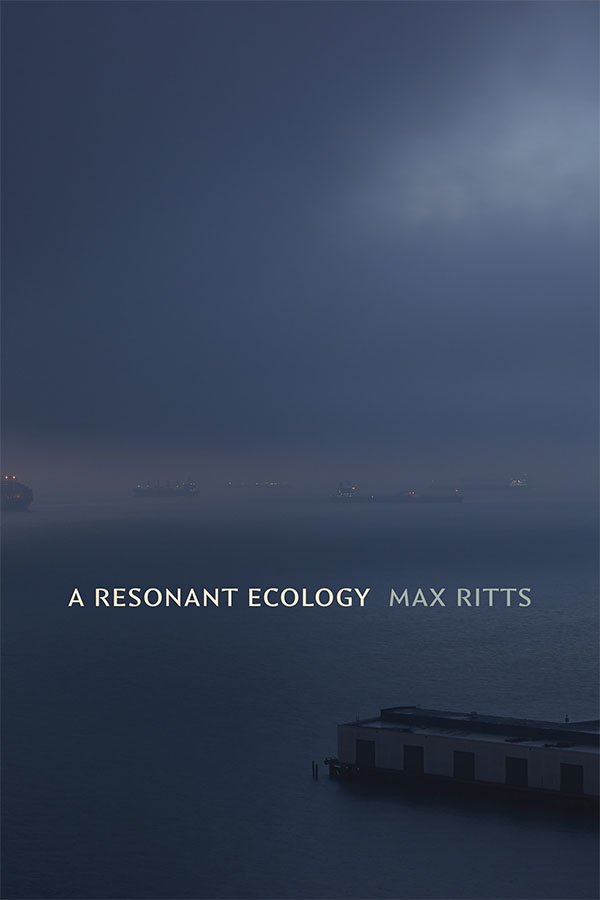
A Resonant Ecology
Review By Laura Jean Cameron
June 23, 2025
BC Studies no. 226 Summer 2025 | p. 153-154
This rich and urgent book by Max Ritts begins and ends in music. First, there is the humpback whale song one might expect in a study attuned to the waters and lands of British Columbia’s North Coast; however, here its invocation is not the usual call to open ears to its otherworldly beauty, in the face of the terrible environmental losses past and yet to come. That’s a refrain that has been echoed by eloquent nature writers, composers and recordists since at least the 1970s and yet the shipping traffic of the fossil fuel business remains ubiquitous and ever more disruptive of coastal ecologies. Just as resonant in these pages are the soundings of Indigenous black metal and the country of Roy’s Orbison’s “Dream Baby”; and, while we are asked to listen, this is listening with the knowledge that listening, in itself, is not redemptive nor reparative. Indeed, Ritts suggests that without careful attention to context—the persistent geographies of capital and colonialism—the sonic turn may well be the wrong turn.
This is a vital message for scholars and activists and anyone who cares about ecological and social justice. How we listen matters—we listen from somewhere—who benefits from our listening? Who now is listening? And what for? In Thousand Mile Song, composer and philosopher David Rothenberg expressed an undercurrent of discomfort with the way the military establishment, that financed much of the early research on whales, remains “an ambiguous influence on our quest to understand the sonic abilities of cetaceans (p. 209)” With a historical materialist toolkit, Ritts centers multiplicity and such ambiguity and argues that sonic digitalization has worked a sea change in the way these questions are now answered. In the first decades of the 21st century, the “we” that is listening has been joined by many novel and powerful entities rapidly expanding in Smart Oceans thick with sonic data deemed ripe for extraction and desirous of predictability for capital flows. In such waters where human sense knowledges are actively devalued, treasured words giving meaning to place and identity like “community” and “share” are hungrily subverted to capitalism and industrial expansion.
Ritts is a compelling guide through complex coastal terrain as he focuses our attention to the geographical qualities of sound. We begin at Cetacea Lab on Gil Island, a rustic research station situated in Whale Channel north of Bella Bella and journey through myriad places key to his case studies; from village ports experiencing the din of development to the coffee machine gurgles and conversations in Prince Rupert’s Tim Horton’s. As a participant observer, Ritz is keenly conscious of his own positionality in relation to past traditions linked to conquest and ideologies of white supremacy, particularly those situated on the coast. These include the missionary bells at Metlakatla that disrespected different ways of sensing, and the extractive practices of salvage ethnography. These sonic geographies (and those repressed) resonate through to the present and, with the striking example of American anthropologist Franz Boas and his North Coast ethnographic work on sound, Ritts contributes a troubling origin story and likely birthplace for the now burgeoning field of sound studies.
While the status of sound is shown to be uncertain, distinct limits in field research matter for Ritts. Informed by Audra Simpson’s work on the relation of refusal to sovereign authority, Ritts’s project confronts Boas’s “prefigurative sonic extractions” from the Ts’msyen and other colonial legacies of practice and theory by, in part, being clear about limits. There are moments in the book, for instance, when he (along with his readers) must acknowledge an important silence, such as a limitation to details about his collaborative recording with Gitga’at First Nation creating an acoustic “baseline” of coastal life: an ethnographic study of this particular (seemingly generative and hopeful) project was not part of the protocol agreement. Closely attentive as well to Dylan Robinson’s discussions of possessive practices of listening, there is much to learn here about how one might conduct relational and accountable research in Indigenous territories—and then tell about it.
There is so much else that is valuable and inspirational about this book. Ritts’s research in place makes the case that the industry promise of ‘sustainable marine development’ —due to all its sonic monitoring, mapping and digital data collection—is, historically and frankly, a falsehood. Historical geographers will be affirmed that in attending to deep contexts and non-human agencies, their discipline is more than equipped to grapple with rapidly changing worlds. Ritt’s theoretical scaffolding is rigorous and his footnotes are generous with fascinating connections and leads. But while this book also makes lucid contributions to science and technology studies, musicology and animal geographies, Ritts is an engaging writer and A Resonant Ecology invites a wide readership amongst coastal communities. A chapter recounting the powers of sound as expressed in the Indigenous black metal band Gyibaaw is both surprising and gripping. The book ends on the upbeat with a discussion of data sovereignty and the possibilities of new relationships through sonic rematriation. His final questions are no less resonant than those that instigated this generative project: “What would it mean for settlers to de-possess the songs that they have taken from these lands and waters – from Indigenous musicians but also from whales and rivers and wolves?” (p. 132)
Publication Information
Ritts, Max. A Resonant Ecology. Durham: Duke University Press, 2024. 216 pp. $25.95 paper.