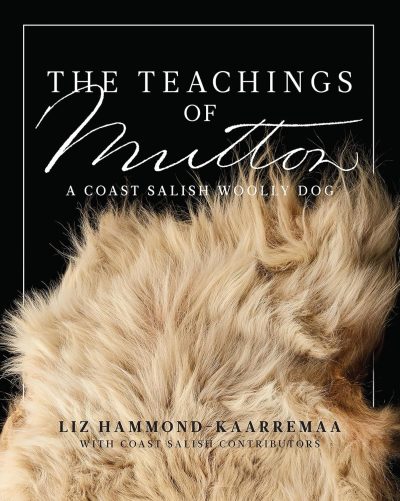
The Teachings of Mutton: A Coast Salish Woolly Dog
Review By Brandon Gabriel
May 19, 2026
The Teachings of Mutton: A Coast Salish Woolly Dog brings forward a history that, for many Coast Salish people, was never fully gone—only interrupted, misnamed, or held in places that did not know how to care for it. Through contributions by knowledge keepers, artists, and scholars such as Alison Ariss, Andrea Fritz, Chepximiya Siyam Chief Dr. Janice George, Danielle Morsette, Debra Qwasen Sparrow, Eliot White-Hill Kwulasultun, Jared Qwustenuxun Williams, Kerrie Charnley, Liz Hammond-Kaarremaa, Michael Pavel, saꬷfamitća Susan Pavel, Senaqwila Wyss, Snumithia’ Violet Elliott, Tuwuxwul’t-hw Tyrone Elliott, and Xweliqwiya Rena Point Bolton, the book brings together teachings that live across generations, disciplines, and territories.
This review asks how the text reframes the Woolly Dog—not as an extinct object of study, but as a relative whose teachings continue to move through Coast Salish life. Rather than standing at a distance, I approach this work as both reader and practitioner, recognizing that the knowledge held here is not abstract. It is carried in practice, in responsibility, and in relationship.
In much of Western scholarship, the Woolly Dog is described in the past tense—catalogued, measured, and ultimately closed. This book refuses that closure. It does not deny the material loss, but it challenges the authority of the word extinct when applied to a being whose presence continues in teaching, memory, and practice.
What emerges instead is a different understanding of time and continuity. The Woolly Dog is not only what was, but what remains in the work of hands, in the knowledge of wool, and in the relationships that persist between people, land, and non-human relatives. The text shifts the question from When did it disappear? to Where does it continue?
The book’s methodology does not separate knowledge from the people who carry it. Archival records and anthropological accounts are present, but they are not centered. Instead, they are placed alongside oral histories, weaving practices, and lived experience—sometimes in agreement, often in tension.
Contributors such as Susan Pavel and Senaqwila Wyss remind the reader that knowledge is not only something written down. It is something done. It is something learned through the body, through repetition, through relationship to land and material.
From a Coast Salish perspective, this is not a blending of methods—it is a re-centering. The work returns authority to those who have always held this knowledge, even when it was not recognized by institutions.
This publication speaks directly to the history of anthropology and museum studies, but it does so without asking permission. It does not simply critique the archive—it repositions it.
Where earlier scholarship often treated Coast Salish knowledge as source material to be extracted, this text insists on accountability. It asks: who has the right to tell these stories? Who benefits from their telling? And what responsibilities come with holding this knowledge?
By presenting multiple voices rather than a single authoritative narrative, the book disrupts the structure of academic authorship itself. It reflects a Coast Salish way of understanding knowledge as something held collectively, not owned individually.
The analytical framework of the Five C’s is present, but it operates differently here:
- Citing becomes an act of acknowledging lineage and responsibility, not just referencing
- Comparing and Contrasting reveal not just differences in method, but differences in
- Critiquing is grounded in lived impact, not abstract
- Connecting extends beyond texts, linking people, practices, and
This book does not raise the Woolly Dog from the past. It shows that it was never fully placed there.
What has been called absence is, in these pages, revealed as distance—distance created through interruption, through collection, through the quiet authority of institutions that did not know how to listen. Here, that distance is shortened.
The Woolly Dog returns not as image or artifact, but as teaching. In the turning of wool. In the remembering of hands. In the careful, deliberate work of those who continue to carry what was nearly set aside.
Reading this as a Coast Salish artist and scholar, I do not encounter something new. I encounter something familiar, brought forward with care, with clarity, and with the weight of many voices standing together. The book does not claim to complete the story. It opens it.
And in doing so, it places a responsibility on all of us—not only to recognize these teachings, but to consider how we carry them forward. Not as observers, but as participants in an ongoing weaving.
Publication Information
Hammond-Kaarremaa, Liz. The Teachings of Mutton: A Coast Salish Woolly Dog. Madeira Park: Harbour Publishing, 2025. 264pp. $24.95 paper.