Unearthing Forgotten Values
Review By Andrew Martindale
May 7, 2026
BC Studies no. 229 Spring 2026 | p. 153-155
Archaeology has only a minor role in Canadian society, but its influence can be profound. It recurs as part of a narrative of adventurism and heroic struggle in popular conception, but the reality is far more mundane and when done well, even boring. This fictitious vision of archaeology is not benign but feeds into dominant cultural tropes that frequently replicate asymmetries and stereotypes regarding issues such as gender, race, and Canada’s historic and ongoing colonialism. The expectation of dramatic discoveries that revolutionize understanding obscures both the benefit of methodologically assembled representative data and the interpretive gaps that exist when these are absent – gaps that often get filled by the fictions that a largely non-Indigenous discipline tells about itself.
Few Canadians recognize that the practice of archaeology in Canada is industrial (a vast majority of archaeological activity in Canada is conducted by private-sector for-profit companies) and that heritage legislation is largely designed to weigh the damage to heritage landscapes against the economic benefits of development. When the narrative possibilities of archaeology blend with the allocations of benefit from colonialism and capitalism, the discipline can become an active agent in the dispossession of Indigenous lands and other rights.
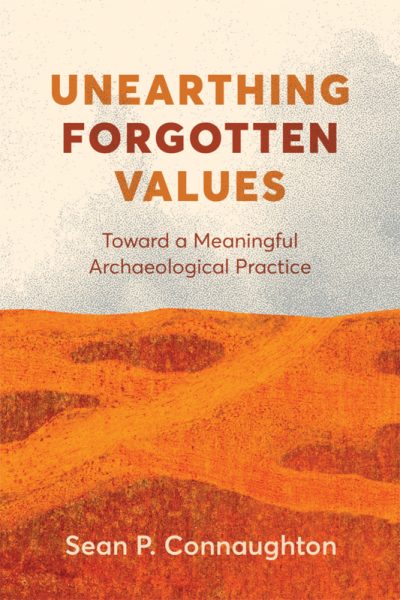
Sean Connaughton’s recent book, “Unearthing Forgotten Values: Toward a Meaningful Archaeological Practice” is a welcome exploration of this reality, its history, and its implications. Like many archaeologists, Connaughton moved from an academic path, resulting in a PhD, to the private sector Cultural Resource Management (CRM) industry. His experience is wide, and he is now the senior archaeologist and manager of Inlailawatash – a Tsleil-Waututh First Nation owned archaeological consulting company. His breadth of experience in academic and consulting roles in the US, Papua New Guinea, and across British Columbia provide him with a range of perspectives on the discipline. He concludes what most archaeologists concede – that archaeology is in crisis and has frequently become a means for governments and development proponents to ignore the rights of Indigenous people.
Few Canadians recognize archaeology’s significance in the evaluation of the heritage impacts of development from massive national infrastructure projects to back yard renos. Any impact to heritage requires assessment for its effect on material culture and mitigation prior to any disturbance. Heritage legislation in Canada is a provincial and territorial jurisdiction, but most bifurcate heritage across a threshold of colonial contact, creating separate regulatory frames that generally divide into archaeology of Indigenous heritage and historic preservation of colonial heritage. The former is the domain of CRM and the assessment of what has value in the landscapes of Indigenous heritage resides almost exclusively with archaeological consultants informing government regulators. Indigenous communities have only a limited role.
This creates the dilemma at the heart of Connaughton’s analysis: can archaeology live up to its self-declared claims of ethical behaviour in the context of late-stage predatory capitalism that converts heritage into a resource and regulates archaeological practice against the requirement of profit? Connaughton’s answer is that it currently does not, and his book is an essential resource for anyone in or impacted by archaeology. It will be of particular value for Indigenous communities seeking to unravel the complexities of heritage regulation and for students considering a career in archaeology. Both audiences will gain insight into the inner workings of the CRM industry and the underlying forces that drive the discipline.
Connaughton’s book is part autoethnography and biography, part history lesson on Canada’s policies regarding Indigenous peoples, and part insightful academic assessment of the dynamics of power operating within and upon archaeology. He centers himself throughout as a means of calibrating his own positionality in these issues – a welcome evaluation of his own limitations and educational growth, especially under the guidance of Indigenous knowledge holders. His long experience within the BC CRM industry allows him considerable insight into the countervailing forces within CRM including the tensions between proponents (who want to build and make money), governments (who want developers to succeed and fill provincial coffers but must at least appear to be stewards of Indigenous heritage), Indigenous communities (who must operate within capital markets but for whom heritage is not a resource but the sacred legacies of their ancestors) and archaeologists (who must be profitable while attempting to be ethical). In Connaughton’s assessment, the tensions within these are pulling archaeology apart.
Unearthing Forgotten Values begins with Connaughton’s biography in archaeology and provides both insight into his character and traces an early and ongoing concern about the compromises required. We learn that he is and remains an ebullient optimist, a tone that characterises this work. He moves then to a detailed exploration of archaeology within heritage legislation, focused largely on BC, though the principles are global. The middle of the book is a welcome evaluation of key elements and documents exploring Indigenous rights in Canada including Canada’s Royal Commission on Aboriginal Peoples, the Truth and Reconciliation Commission of Canada’s Final Report, focusing on its Calls to Action, and the United Nations Declaration on the Right of Indigenous Peoples – which in BC are the basis of the 2019 Declaration on the Rights of Indigenous Peoples Act. This section is both essential reading for all archaeologists (indeed all Canadians) and a subject that receives far too little acknowledgement and understanding in non-Indigenous Canada. The final sections focus on the core values, drawn in part from Indigenous scholars, that would be the basis of a reimagined archaeology: acting in good relation, prioritizing Indigenous goals, valuing Indigenous heritage including the allocation of significance and the benefits of archaeology, reciprocal capacity building including expanding Indigenous participation in archaeology, and relinquishing control of indigenous heritage by non-Indigenous authorities.
I admire Connaughton’s assessment and vision for a reformed archaeological practice, though if I have a concern about this argument, it is its naiveté. Connaughton argues that, “a lot of good can come from inserting compassionate, human values into archaeological practice.” I agree but also note that archaeologists have consistently made this case since the beginning of the CRM era in the 1960s and nothing has changed. I fear that the obstacles that Connaughton sees as bugs in the archaeological system are rather features of design that serve, intentionally, to marginalize archaeologists and disenfranchise Indigenous peoples from their heritage. The recent abandonment by the provincial government of efforts to reform the Heritage Conservation Act to conform to its own Declaration on the Rights of Indigenous Peoples Act is a case in point.
Connaughton’s exploration of these issues seems not to fully reach their potential. He explores Marxism’s assessment of capitalism but does not consider either the unsustainability of use-value economics or the deployment of false consciousness by its beneficiaries. He considers regimes of value, but without framing the social imaginary that recruits, enforces, and obscures inequalities. He explores positionality but without attention to insights into structure that subaltern positionalities provide and to which the beneficiaries of unfair structures are ignorant.
These are minor quibbles regarding the framing of Connaughton’s argument, but they allow us to unravel not just how archaeological practice cannot fulfill its self-declared ethical principles, but why. Connaughton’s logic is especially relevant today when the provincial NDP government seeks to repeal its own DRIPA legalisation – an acknowledgement of the thesis of this book that living up to these values of responding equitably to colonial consequences would transform the province of British Columbia. BC Premier David Eby seem unwilling to see this transformation occur, likely because it would shift power over territory from his office to First Nations. Connaughton in contrast argues that such a shift is the only path forward for archaeology – if we are to live up to our values.
Publication Information
Connaughton, Sean P. Unearthing Forgotten Values. Vancouver: UBC Press, 2025. 222pp. $34.95 paper.