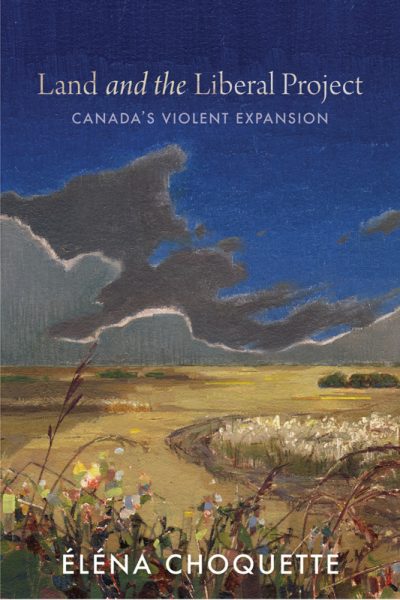
Land and the Liberal Project: Canada’s Violent Expansion
Review By Mckelvey Kelly
May 7, 2026
While many view Canada as a “peaceable kingdom” rooted in benevolent colonialism and multiculturalism, Éléna Choquette expertly interrogates these national narratives. She exposes the disconnect between the perception of peaceful expansion and the lived realities of violence and genocidal nation-building practices. Challenging the notion that Canadian forms of colonization were more law-abiding, gentle, and less bloody than those of countries like the United States and Australia, Choquette argues that settlers explicitly used violence and genocide to lay claim to land and assert their control over it, despite framing their authority through constitutionalism, administration, and law in the wake of Canadian Confederation in 1867.
Choquette’s central contribution is the decolonization of liberalism. She successfully reveals how ideas of liberty, self-government, and economic prosperity functioned as the primary tool of dispossession that justified colonialism. She demonstrates that the Dominion government rooted their arguments of land acquisition in concepts of “improvement” wherein the state claimed a unique mandate to “improve” both western lands and Indigenous Peoples. To distinguish these practices, she conceptualizes the term “colonial liberalism,” which was a framework that justified the appropriation of Indigenous lands and the infliction of genocide in the late nineteenth century.
The author’s use of terminology is particularly effective in conveying the complexity of identity in North America. Following scholar Jodi Byrd, Choquette employs the term “arrivants” to describe individuals who did not arrive by choice, including enslaved peoples, indentured servants, mentally disabled peoples, and criminals. This important distinction between settlers and arrivants recognizes their complex backgrounds as both settlers that contributed to the dispossession of Indigenous peoples from their ancestral lands and people with diminished autonomy to fight settler colonialism.
By examining archival records like government reports, parliamentary debates, legislation and Acts, newspapers, travel papers, correspondence, and legal records, this book reframes Confederation through the lens of Indigenous resistance and the state violence the Dominion of Canada undertook to suppress it. Choquette shows that policies like treaties and enfranchisement that were presented as benevolent choices, were actually ultimatums where Indigenous Peoples were expected to assimilate or face military consequences. She traces this through the 1869, largely Métis-led, Red River Resistance, the creation of Manitoba, the incorporation of British Columbia, and the creation of the Northwest Mounted Police. The subsequent military response to the 1885 Métis Resistance and implementation of the Indian Act, and the Indian Residential School System, further demoted non-Western peoples to “various states of containment and diminished humanity” (102). In this way, “colonial liberalism” proved just as violent as imperialism physically (against the body and spirit), materially (against the land), and epistemically (against knowledge and culture).
While this book expertly details the colonial project since the 1850s, readers who are unfamiliar with the history of the Hudson’s Bay Company (HBC) and larger fur trade may have a hard time contextualizing the first chapter of Choquette’s book. The book jumps right into the looming expiry of the HBC’s 1670 Royal Charter over Rupert’s Land without explaining how the HBC received the charter in the first place or the company’s assumed authority over western lands, which would have further strengthened the book’s central thesis. Nevertheless, this book is a vital addition to post-Confederation survey courses, settler colonial studies, and legal history. In particular, this book would be an excellent textbook for a second or third level spring/summer six-week Pre-confederation Canadian history course following the book’s chapter outline. While the work is not an Indigenous history, scholars of Indigenous Peoples can use this book for language to describe and challenge the notion of Canada’s benevolent colonialism and justification of stolen lands.
More importantly, Choquette demonstrates that the “peaceable kingdom” was a functional tool of settler colonialism that was deliberately used to obscure the violence of land theft and repeated attempts to assimilate Indigenous Peoples. By showing how colonial officials obscured their epistemic violence of genocide by “cloak[ing] their recommendations in a deceiving language of generosity and peace” (42), Choquette encourages Canadians to think critically about contemporary liberalism and “reject the ideas that justify European sovereignty over Indigenous lands and peoples” (8). As Choquette suggests, without Canadians realizing this historical truth, there can be no genuine reconciliation and path forward.
Publication Information
Choquette, Éléna. Land and the Liberal Project: Canada’s Violent Expansion. Vancouver: UBC Press, 2025. 232pp. $34.95 paper.