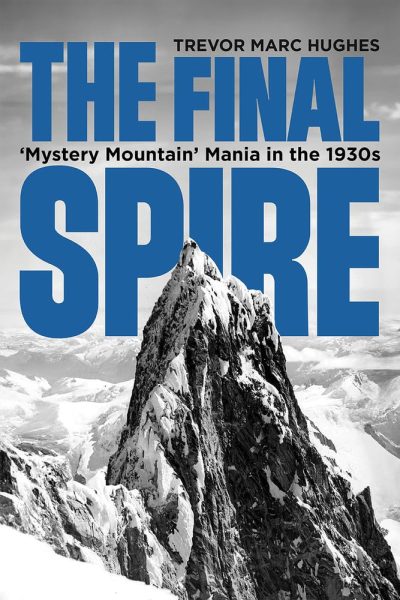
The Final Spire: ‘Mystery Mountain’ Mania in the 1930s
Review By PearlAnn Reichwein
May 7, 2026
Early climbers set out to explore for a “Mystery Mountain” in the 1920s. For the next decade, the first ascent of Mount Waddington and its elusive “final spire” grew into a tantalizing saga of mountaineering exploits in Canada’s Coastal Mountains. During the interwar era of burgeoning imperial mountaineering exploits around the world from Mount Everest to Canada’s highest summit Mount Logan in the Yukon, the new mountain gained notoriety as a giant believed to be Canada’s highest unclimbed peak. Exploring the British Columbia coastline north of Vancouver led peak baggers to the “unknown mountain,” while the mountain was, in fact, known among the Xwémalhkwu People by its Homalco name Xwe7xw. Trevor Marc Hughes follows the saga of these mountaineering expeditions in early twentieth-century Canada.
Before tracing these British Columbia expedition narratives in the 1920s to the 1930s, the book backtracks to Victorian mountaineering and the sublime based on Ronald Clark’s 1953 book The Victorian Mountaineers. A 1924 Geological Survey of Canada report put the mountain on the radar for Vancouver climbers Don and Phyllis Munday. In 1925, they sailed to Bute Inlet and launched a decade of exploratory trips and attempts to reach the summit. The Mundays were committed mountaineers: Phyllis was an award-winning photographer (and later the Canadian Alpine Journal editor), and Don wrote many mountaineering accounts, including the 1948 book The Unknown Mountain. Their accounts led to a mountain “mania” that Hughes describes as it diffuses from the British Columbia Mountaineering Club (BCMC) to the Alpine Club of Canada (ACC) in the Canadian Alpine Journal, then the Sierra Club Bulletin and the American Alpine Club (AAC) in the American Alpine Journal in the United States. A Winnipeg team with brothers Roger and Ferris Neave of the ACC attempted the mountain in 1934. A roster of North American’s best climbers tried for the frozen spire on at least thirteen attempts until – spoiler alert – the first recorded ascent of the summit led by German-born alpinist and rock climber Fritz Weissner in 1936. Well-executed expedition tactics (drawn from the Himalayas) and climbing techniques honed in the Alps took Weissner and his AAC team to the summit.
The book aims to drive mountaineering stories forward trip-to-trip, however the chapter structure tends to distract with backward loops in time. Many archival photographs illustrate the book yet photo captions lack details, such as the year and photographer, to add depth to reading. Sketch maps, endnotes, a bibliography, a list of illustrations, and a basic index round out the book.
This selection of Mount Waddington stories connects a regional axis of mountaineering communities from the Vancouver mountaineers with others on the Canadian Prairies in Manitoba and across the Pacific Northwest to California. The role of Canadian and American mountain clubs and mountaineers is apparent in expeditions by the Mundays, Neaves, Weissner, and many others, but also brings to light local people – both Indigenous and settler – who populated the Coastal region and a few who assisted mountaineers to find their way toward the peak. The book draws mostly on trip accounts published in mountaineering publications. Reading the BCMC newsletters sheds light on how expedition stories circulated by means of regional and national climbing publications, and eventually attracted newspaper coverage and broader public fascination. Expeditions published certain stories of Mount Waddington. Whose stories had top billing and whose stories remained silent?
Contemporary historians of mountaineering have described alpinism and climbing at the intersection of Romanticism, athleticism, and nationalism, also framed by class, gender, ancestry, and imperialism. Karen Routledge broke new ground in her analysis of mountaineer Phyllis Munday; likewise, Christopher Dummitt reappraised the BCMC as an expression of interwar modernity and manhood. Both works are pertinent to any Mount Waddington bibliography yet overlooked here. Many historians have focused on terrain and new techniques in the interwar era of rock climbing. Hughes returns to Ruskin and English Romanticism as the spiritual wellspring of modern mountaineers and the quest for Mount Waddington, veiled as a mystery mountain and mythological muse.
Overall, Hughes casts mountaineering as a pilgrimage in the tradition of Romanticism. Affirming the international climbing world pursued a “spirit” of the mountains and a nascent environmental movement stemming from Ruskin and the English Romantics, this book concludes that the ascension of Mount Waddington was a mountaineering story that fired the imagination and spirit. Canadian and American mountaineers were significant amid the conservation, social, economic, and political struggles of the 1920s and 1930s, however this book does not focus on that history. Instead, the book resonates with Victorian mountaineering as pilgrimage, offering an incomplete picture of the interwar mountaineering world and a changing era of ascents. The zeitgeist of major expeditions owed more to the battlefronts of the Great War, competition, and athleticism than the Victorian sublime alone as attested by peak bagging on Mount Waddington and the hunt for “first ascents” worldwide. General readers can romp through mountain adventures in this book, but the legacy of the “final spire” returns to questions of imperialism and masculinist hegemony in the archives of mountaineering and the reinscription of modern mountaineering conceits in historical research and non fiction.
Publication Information
Hughes, Trevor Marc. The Final Spire: ‘Mystery Mountain’ Mania in the 1930s. Vancouver: Ronsdale Press, 2025. 236pp. $24.95 paper.