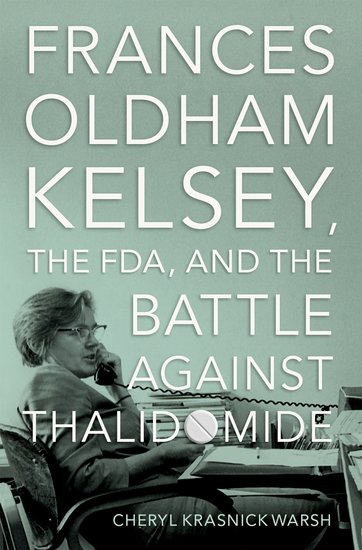
Frances Oldham Kelsey, the FDA, and the Battle against Thalidomide
Review By Lauren MacIvor Thompson
November 18, 2025
BC Studies no. 227 Autumn 2025 | p. 209-211
In the early 1960s, Dr. Frances Kelsey was an officer at the U.S. Food and Drug Administration who famously prevented the dangerous drug thalidomide from formally entering the American market. For this book, Warsh interviewed not only Kelsey herself but also her family members, and closely mined Kelsey’s voluminous papers. The result is an authoritative biography that seamlessly weaves Kelsey’s life story with a broader history of twentieth-century pharmaceutical regulation and consumer protection efforts.
The book is organized chronologically into twenty chapters, exploring Kelsey’s journey from her childhood in British Columbia to her career in the United States. She eventually began her doctoral studies under the direction of Dr. Eugene Geiling, the chair of the Department of Pharmacology at the University of Chicago. Kelsey completed her PhD in 1938, but it was difficult for her to cobble together employment. At one point, she was offered a position at Dalhousie University in Nova Scotia as a graduate assistant, but the wages were abysmally low. Warsh asks, “Should Frankie have taken graduate student wages for the opportunity of employment? If she had, she would have followed in the footsteps of many female scientists…who were forced to submit to low wages and status to keep a foot in the door of the profession…” (47). After her marriage to Ellis Kelsey, a pharmacology professor whom she had met in Geiling’s lab, she decided to earn an M.D. As Kelsey herself pointed out, “of course, as a woman, I needed the extra credentials…” (69). Ellis eventually landed a position as chair of the pharmacology department at the University of South Dakota, while Kelsey took care of their two daughters and was relegated to temporary or unpaid research positions and part-time work as a physician.
The Kelseys arrived in Washington D.C. in 1960 after both receiving better career offers. Kelsey began as a medical officer at the FDA, reviewing new drug applications and quickly discovering that in the approvals process “science was only one factor, and often a minor one…” (92). Warsh deftly explains the landscape of pharmaceutical regulation in the mid-twentieth century, wherein drug representatives offered big “honoraria” to government agents to get their product past FDA’s red tape. Clinical trial records were haphazard, samples were widely distributed, and injuries and deaths were mostly unreported. Kelsey dealt with a heavy caseload and immense pressure, making her intervention in the thalidomide crisis even more remarkable for her persistence.
Warsh compellingly lays out the stakes of thalidomide’s side effects of birth defects and miscarriages. Originally developed in the late 1950s by a German company, it functioned as a sedative and anti-nausea therapy. Marketed under the brand name Contergan, it was advertised as “so harmless that children could be dosed with it so that parents could go to the movies…” (105) and was prescribed in pregnancy. In the US, the company William S. Merrell was licensed to market thalidomide under the name Kevadon. With a target date of December 1960, Merrell “had ten million tablets of Kevadon waiting in American warehouses to be shipped out” (104). In the meantime, however, Merrell also distributed the drug to American physicians, legal at the time under loose regulations. Individual physicians often did not keep records of the prescriptions.
Warsh deftly navigates through a maze of regulatory and chronological detail with the skill of a suspense novelist. When Kelsey reviewed the application, her team had sixty days to make a decision. They immediately identified serious issues with the studies submitted. For the next few months, Kelsey continued to push back against Merrell’s negotiations to bring Kevadon to market, citing both the need for more data on its absorption rates and the worrisome reports from Europe of babies born with phocomelia. Merrell ultimately withdrew their application. For this, she was hailed as a hero and helped expand the FDA’s regulatory authority.
Throughout, Warsh evaluates Kelsey’s career as a woman scientist through a critical lens of postwar gender politics. Kelsey was praised for her work in preventing tragedy, but always through a framing that identified her first as a mother and wife. A typical news story noted her success was due to “luck, scientific know-how and her bio-chemist husband’s backing” (129). Warsh explains, “In this Cold War period of domestic containment, where the maintenance of clearly defined gender roles was portrayed as the first line of vital defense against Communist incursion, Kelsey’s persona was an affirmation that even women in the most unorthodox of roles could be assets to the nation without threatening the home” (129).
Warsh warns readers at the outset that this is not a history of the FDA or drug regulation more broadly. But Warsh offers us an important look at an agency that served as a space for women to become involved in scientific research. Throughout her career, Kelsey “maneuvered around and through political intervenors and demands on her time and energies from her superiors, the public, and the pharmaceutical companies.” Yet we also are treated to a glimpse into how Kelsey’s private life was a rich one, full of “interesting sights to see, engaging people to meet, and a warm home to unwind in at the end of the day” (208).
Publication Information
Warsh, Cheryl Krasnick. Frances Oldham Kelsey, the FDA, and the Battle against Thalidomide. New York: Oxford University Press, 2025. 424pp. $39.99 hardcover.