
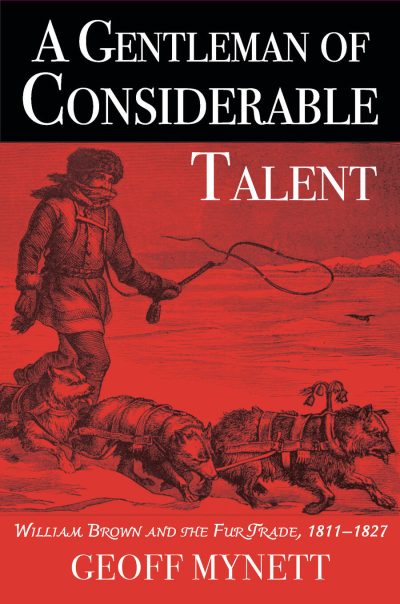
A Gentleman of Considerable Talent: William Brown and the Fur Trade, 1811-1827
Review By Tyler McCreary
November 18, 2025
BC Studies no. 227 Autumn 2025 | p. 202-203
In his newest book, A Gentleman of Considerable Talent, Geoff Mynett focuses on the life of Hudson’s Bay Company trader William Brown. Neither a prominent figure in the fur trade nor an accomplished explorer, Brown’s story is significant precisely for its ordinariness. Through his peripatetic career in the fur trade, Mynett captures the precarious existence of a middling trader living through an era of imperial upheaval and corporate rivalry.
In the opening chapters, Brown first appears as a roguish protagonist of modest means whose story showcases HBC indifference to its lower ranks. Born in Kilmaurs, Scotland, Brown was recruited to the HBC in 1811 on a three-year contract. Chaos erupted even before his departure. Agents of the rival North West Company interfered with port paperwork and fomented dissent among recruits. Stalled in port, events escalated, with fights and desertions. After leaving port, circumstances remained harrowing, as the barely seaworthy vessel he was aboard made a perilous Atlantic crossing.
Conditions worsened upon arrival at York Factory. As a consequence of travel delays, the passengers only disembarked as winter began. The mix of Red River settlers and new fur trade recruits that made the journey were forced to overwinter in an encampment on the Nelson River. Freezing temperatures, scarce provisions, limited available fish and game, and eventually the onset of scurvy defined the experience. Ethnic tensions between Irish and Scottish contingents boiled over into violence. Leadership was divided, and mutiny ensured, with Brown emerging as its leader. Lacking food and supplies, the mutineers ultimately relented. For the HBC, a desperate need of labour overrode its desire for discipline, and the men were readmitted into its employ.
Although Mynett provides a compelling recounting of these events, he did not pen a picaresque adventure. Rather, the narrative pivots toward Brown’s rehabilitation as loyal servant of the company. Posted to a remote Arctic outpost on Reindeer Lake, he endured years of isolation and privation before returning to Scotland in 1815. There he married his old paramour. She had already born him a daughter in 1810 and birthed a second in 1816. Brown, however, remained restless and returned to HBC employ in 1818.
Brown’s second term thrust him into the fur trade wars between the HBC and the Nor’Westers. Brown initially coordinated four forts around Lake Manitoba. Amidst escalating conflicts, rivals from the competing companies ambushed and arrested (read kidnapped) one another. Transferred north to the Great Slave District in 1819, Brown was tasked with opening a new fort. Yet company parsimony and weak leadership left him under-resourced, and he spent a desperate winter starving at Fort Resolution. The following year he moved to Fort Wedderburn, near the strategic North West Company hub at Fort Chipewyan, where he became embroiled in further intrigues, including the capture and detention of Nor’Wester chief Simon McGillivray.
In 1821, the companies merged. Brown took a post in New Caledonia, founding Fort Kilmaurs on Babine Lake and seeking to extend the trade into Gitxsan territories. The five years at Fort Kilmaurs were less austere than his Arctic service, although conflict with his district superior, a former Nor’Wester John Stuart, persisted.
Stuart vehemently opposed the HBC practice of fur traders taking “country wives” from local Indigenous communities. Brown had at least one such wife, Josette, and possibly a second, Fanny. While this practice was common, it was rarely mentioned in fur trade journals. Thus, Stuart’s campaign against it provides valuable documentation of the interracial relationships that followed the fur trade. As Mynett recounts, these relationships could become a source of disputes not only between HBC traders but also with the surrounding Indigenous community.
Stuart also opposed Brown’s designs to travel down the Babine and upper Skeena rivers to open trade with the Gitxsan. Brown nonetheless appealed directly to the HBC governor, arguing that Skeena exploration was necessary to counter the influence of coastal traders. He made preliminary journeys to the Gitxsan villages along the Babine canyon, but illness ultimately restricted his travel. Forced to abandon his ambitions, he returned to Scotland in 1826, dying just six months later.
Mynett’s biography of Brown is an engaging portrait of an ordinary fur trader negotiating the brutal contingencies of imperial commerce. The book’s strength lies in the author’s close and careful reading of archival sources. His prose is clear and economical, and he brings an impressive range of documentation together in a coherent narrative.
Yet his account also has gaps. Indigenous peoples, though central to the fur trade, appear largely at the margins of the story. Mynett provides glimpses into their practices, for instance describing ritual gift exchanges among the Dakelh and Gitxsan. But his steady focus remains on the intrigues and interpersonal conflicts among the fur traders. The result is a history that vividly depicts the world within the fort while leaving the surrounding Indigenous world faintly sketched.
Still, Mynett succeeds in humanizing a figure who would otherwise remain unknown. Brown’s story is less about heroic discovery than about endurance, adaptation, and the ambiguous loyalties of men at the edge of empire. A Gentleman of Considerable Talent thus helps recognize the lives of the ordinary actors of the colonial past—even as it leaves open questions of how those lives were entangled with the Indigenous worlds that made them possible.
Publication Information
Mynett, Geoff. A Gentleman of Considerable Talent: William Brown and the Fur Trade, 1811-1827. Qualicum Beach, BC: Caitlin Press, 2024. 204pp. $26.00 paperback.