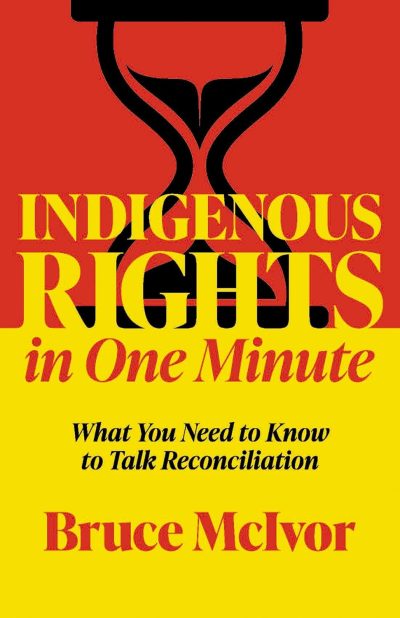
Indigenous Rights in One Minute: What You Need to Know to Talk Reconciliation
Review By Trevor Green
November 18, 2025
BC Studies no. 227 Autumn 2025 | p. 200-202
In a recent interview, Bruce McIvor quipped that he wrote Indigenous Rights in One Minute: What You Need to Know to Talk Reconciliation for people with short attention spans. At just over 200 pages, his latest work is a quick, enjoyable, even breezy read. Written as a series of Q&As, the book is meant for readers outside the legal profession who want to learn about Aboriginal law, Indigenous rights, and how the court interprets its duties.
What’s refreshing about McIvor’s book is that he makes no qualms about the contents of the book being his take on the legal system. Although always striving for accuracy, he emphasizes that he “never tries to be objective” (4). He says he accepts that lawyers, judges, and dissenting scholars might disagree with his interpretations and opinions; he is not only willing to have others disagree with him, but welcomes debate, inspiring trust and confidence in the reader.
In aim and scope, McIvor’s book joins a growing body of literature that has appeared since the release of the Truth and Reconciliation Commission Calls to Action in 2015. It can be placed next to informative, reader-friendly works meant for people who are perhaps unsure or hesitant about how to contribute to reconciliation – works such as Bob Joseph’s 21 Things You May Not Know About the Indian Act, Jody Wilson-Raybould’s True Reconciliation: How to Be a Force for Change, and David Alexander Robertson’s 52 Ways to Reconcile: How to Walk with Indigenous Peoples on the Path to Healing. It’s important that these books be read, because I am weary of reconciliation being a sort of “buzz word” and not being followed up by concrete action. By reading Indigenous Rights, you can start to have informed, meaningful conversations about issues that not only matter to Indigenous people, but to all Canadians.
Divided into two parts, the first section includes questions the author is most frequently asked as a lawyer. What is the Doctrine of Discovery? Who Qualifies as Métis? Why Does the Crown Have a Duty to Consult? These are responded to with one-sentence answers and further expanded upon in pithy summaries that can be read in a minute or less, so have your egg timer ready.
An adjunct professor at the University of British Columbia’s law school, and a founding partner of First Peoples Law firm in Vancouver, McIvor has spent nearly three decades working on behalf of Indigenous communities. In providing concise answers to a plethora of questions, he draws primarily upon Supreme Court decisions. In the second section, McIvor provides answers to questions about specific court cases, and this section is worth delving into to learn about the inner workings of the Supreme Court. Perhaps because his law practice is in British Columbia, land claims in the province and emerging issues are particularly well-represented, adding regional depth and special value to the book.
Although both sections are informative and accurate, McIvor is at his best when he takes on common misconceptions and persistent stereotypes. For example, most Indigenous people do pay taxes, “lots of taxes,” (29). Didn’t First Nations Surrender Their Land Through Treaties? No, they “did not surrender their land through treaties” (56). As he made palpably clear in his first book, Standoff, McIver is all too aware of the limitations of the law, having represented Indigenous people who are rightly sceptical of a colonizing, Western legal system.
With certain entries, McIvor’s self-inflicted brevity means some of his summaries are not expanded upon in an altogether satisfying manner. For example, in an entry about the importance of the Royal Commission on Aboriginal Peoples, he mentions the “so-called Oka Crisis” without providing a few more sentences for context (98). Also, at times, I would have appreciated more background on the Inuit and their relationship with the law. But these minor quibbles aside, his latest book is learned, well-written, and the sections on treaties and treaty rights are especially well-done. McIvor set out to write an accessible overview of Aboriginal law, and by this yardstick, his book is a success. Indigenous Rights is a useful addition to the growing body of resources written by Indigenous people for a general audience by an author who hopes to advance reconciliation and Indigenous resurgence.
References:
Joseph, Bob. 2018. 21 Things You May Not Know about the Indian Act: Helping Canadians Make Reconciliation with Indigenous Peoples a Reality. Indigenous Relations Press. Port Coquitlam, BC: Indigenous Relations Press.
McIvor, Bruce. 2021. Standoff: Why Reconciliation Fails Indigenous People and How to fix it. Harbour Publishing, Nightwood Editions.
Robertson, David A. 2025. 52 ways to Reconcile: How to Walk with Indigenous Peoples on the Path to Healing. Toronto: McClelland & Stewart.
Wilson-Raybould, Jody. 2022. True Reconciliation: How to be a Force for Change. Toronto: McClelland & Stewart.
Publication Information
McIvor, Bruce. Indigenous Rights in One Minute: What You Need to Know to Talk Reconciliation. Madeira Park, BC: Harbour Publishing, 2025. 224pp. $22.95 paperback.