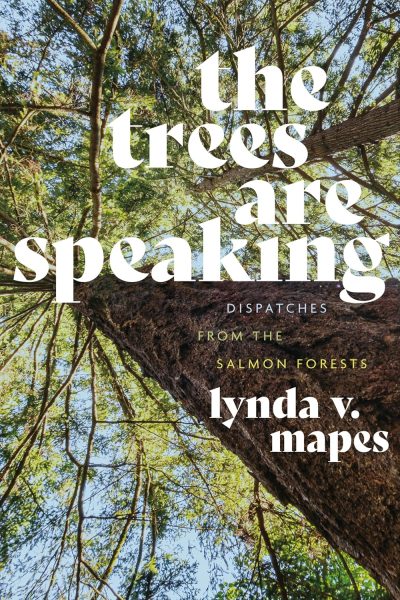
The Trees Are Speaking: Dispatches from the Salmon Forests
Review By Darcy Mathews
November 18, 2025
BC Studies no. 227 Autumn 2025 | p. 196-197
In The Trees Are Speaking: Dispatches from the Salmon Forests (2025), journalist and naturalist Lynda V. Mapes asks what it means to listen to trees, to watersheds, and to Indigenous histories held in these living landscapes. While reading this superb book, I was reminded of my friend Sut̓ᶿəma, an elder with the Songhees Nation, who has long advised me to go to the forest and listen to the trees: to put a hand on their bark, sit amongst them, and deeply listen. She teaches: “Be quiet in this place and listen.” That guidance shapes my reading of Mapes’s work. Listening, in her account, is not a metaphor but a method—a disciplined way of learning from the more-than-human world and of acknowledging our participation in its systems of interdependence.
The Trees Are Speaking is both culmination and evolution of Mapes’s broader work—an inquiry into how attention itself can become a form of ecological and ethical repair. Grounded in the temperate rainforests of the Pacific Northwest, the book follows scientists, Indigenous knowledge holders, and restoration practitioners across the “salmon forests” of Oregon and Washington. Here, marine nutrients carried inland by salmon feed the trees, while those same trees stabilize the streams that sustain the salmon. In this way, Mapes mirrors the listening that Sut̓ᶿəma describes—attentive, embodied, and reciprocal. She shows that listening is not symbolic but material: ecological systems themselves communicate through cycles of exchange. Listening becomes a framework for understanding reciprocity as both process and principle.
This attention to relationship recalls Witness Tree: Seasons of Change with a Century-Old Oak (2017), in which Mapes spent a year observing a single oak in the Harvard Forest to document how climate change impresses itself on living matter. That project established her method—combining scientific observation, patient immersion, and narrative clarity. The oak stood as an individual witness to global transformation. In The Trees Are Speaking, she scales that attentiveness from one organism to an entire bioregion. Where Witness Tree was intimate and meditative, this new work is networked and collective, portraying forests as communities of communication rather than isolated organisms. In doing so, Mapes challenges Western taxonomies that separate people from trees—and, by extension, from our ethical responsibilities toward them.
Threaded through these ecological stories is another register of listening—one that Mapes first explored in Breaking Ground: The Unearthing of the Tse-Whit-zen Village (2015). That earlier work examined how the Lower Elwha Klallam people affirmed that listening to the land means recognizing it as a living record of deep Indigenous history and resilience—and that repair requires ceremony, collaboration, and respect for Indigenous sovereignty. From that experience, Mapes learned that ethical listening requires acknowledgment of colonial histories and movement toward reconciliation. In The Trees Are Speaking, this insight extends to forest and river restoration efforts led by Indigenous nations. She listens not only to scientists but to Coast Salish and Quinault elders whose knowledge reframes environmental management as relational stewardship rather than technical control.
Mapes’s strength lies in her ability to combine journalistic insight with ethical reflection. Her prose is clear and unsentimental, balancing data with empathy. She resists nostalgia and avoids the romantic impulse to treat forests as untouched refuges. Instead, she portrays them as dynamic, altered systems with deep histories of human presence, whose recovery depends on conscious responsibility. In presenting listening as a disciplined form of attention—anchored in observation, humility, and accountability—Mapes shifts environmental reporting from description to relationship, from witnessing to ethical participation.
Across Witness Tree, Breaking Ground, and The Trees Are Speaking, Mapes develops a philosophy of attention. Each book deepens her commitment to reciprocity—between people and trees, history and ecology, knowledge and care. The new work stands as her most integrated and urgent: a narrative of forests as living archives, as kin, and as interlocutors requiring our response. Listening, Mapes suggests, is how we begin to reinhabit those relationships rightly. For readers, it is also an invitation to slow down, to notice, and to recognize that hearing the world around us is the first step toward living well within it. Not as detached observers, but as participants in a shared and fragile conversation.
Publication Information
Mapes, Lynda V. The Trees Are Speaking: Dispatches from the Salmon Forests. Washington: University of Washington Press, 2025. 272pp. $41.00 paperback.