
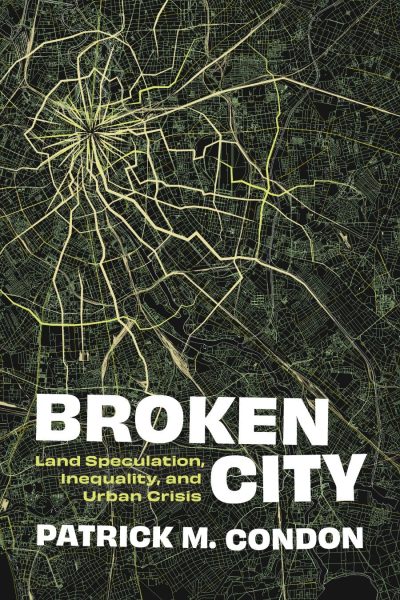
Broken City: Land Speculation, Inequality, and Urban Crisis
Review By Leila Ghaffari
November 18, 2025
BC Studies no. 227 Autumn 2025 | p. 193-194
The role of land in the economy, social inequality, and housing crisis is often overlooked (Ryan-Collins et al., 2023). Patrick M. Condon seeks to address this gap by centering his book on the concept of “urban land” and its role in perpetuating inequality.
Tracing the roots of disparities in wealth, employment, health, and landownership to systems such as slavery and colonialism, Condon argues that the highly uneven control over land lies at the core of these enduring inequalities. The book’s starting point is inequalities in a broad context, leading its way towards inequalities in access to housing. After demonstrating the role of land in housing systems, he evaluates different policies in terms of their impact on housing affordability.
The housing problem, according to Condon, is not a problem of supply and demand. The underlying issue, he affirms, is the rising share of land prices in the overall cost of housing. In many countries such as Canada, the United Kingdom, and New Zealand, the cost of housing has doubled in less than ten years, and Condon links this increase to the appreciation of land value. When land not only becomes the main driver of costs but also absorbs all efforts to decrease construction costs, simply increasing supply cannot improve affordability.
Debates over the role of government in the housing market have long produced two contrasting systems worldwide (Stephens, 2020; Kemeny, 2006). One protects the private market, by all means necessary, from competition with the non-market sector; the other builds a strong non-market sector to balance the private market. These two systems echo the current divide between those who argue that the solution lies in more supply, mainly through deregulation and relying on the “filtering effect” (Glaeser & Gyourko, 2003), and those who believe that only the right kind of supply can address the structural issues that create inequalities in our housing systems. Condon clearly aligns with the latter view, advocating for measures that condition the increase in residential capacity for providing affordability.
It is important to highlight that the author does not dismiss efforts to reduce the cost of construction or residential capacity increase. He rather shows, quite convincingly, that without concrete strategies for controlling land Rent, all the gains we might have from these efforts would be absorbed by rising land prices.
Historically, Adam Smith saw land as one of three production factors alongside capital and labor (1776). As land was subsumed under capital at the end of the 18th century, economic debates became void of the singularities of this form of capital and the monopoly that is inherent in its scarcity and fixed location. Condon reminds the reader of these unique features, urging for a renewed understanding of land’s role in our housing markets, particularly within the English-speaking world.
From this perspective, any effort to make housing more affordable must restrict the flow of capital and labour into land Rents. In exploring how this might be achieved, Condon goes beyond the purist single-tax position that most Georgists recommend. Drawing lessons from successful housing policies in cities such as Vienna, Cambridge, and Portland, he demonstrates that coordinated strategies – limiting land value inflation, asserting public control over land, and strengthening the protected housing sector- can yield permanent affordability.
Measures such as conditioning upzoning with resident income or adding development taxes can drive down land prices. Yet, as Condon cautions, “the wider the gap between current wages and current land prices, the fewer the social benefits that can be demanded without rendering projects unprofitable in the absence of a subsidy” (p. 192).
Condon’s Broken City is more than a critique of housing policy – it is a call to re-examine one of the most fundamental yet overlooked dimensions of modern capitalism. His argument is both timely and persuasive. While the book offers limited discussion of the political and institutional barriers to reform, the clarity of its arguments provides valuable insight for decision-makers seeking to understand why efforts to achieve affordability continue to fall short – and how renewed political will could chart a more equitable path forward.
Bibliography
Glaeser, E. & Gyourko, J. (2003). The Impact of Building Restrictions on Housing. Economic Policy Review. 9. 21-39.
Kemeny, J. (2006). Corporatism and Housing Regimes. Housing, Theory and Society 23 (1): 1–18.
Ryan-Collins, J., Lloyd, T., MacFarlane, L., Muellbauer, J., & New Economics Foundation. (2017). Rethinking the economics of land and housing. Zed Books Ltd.
Smith, A. (1776). The Wealth of Nations. London: W. Strahan and T. Cadell.
Stephens, M. (2020) How Housing Systems are Changing and Why: A Critique of Kemeny’s Theory of Housing Regimes, Housing, Theory and Society, 37(5): 521-547, DOI: 10.1080/14036096.2020.1814404
Publication Information
Condon, Patrick M. Broken City: Land Speculation, Inequality, and Urban Crisis. Vancouver: University of British Columbia Press, 2024. 274pp. $32.95 paperback.