
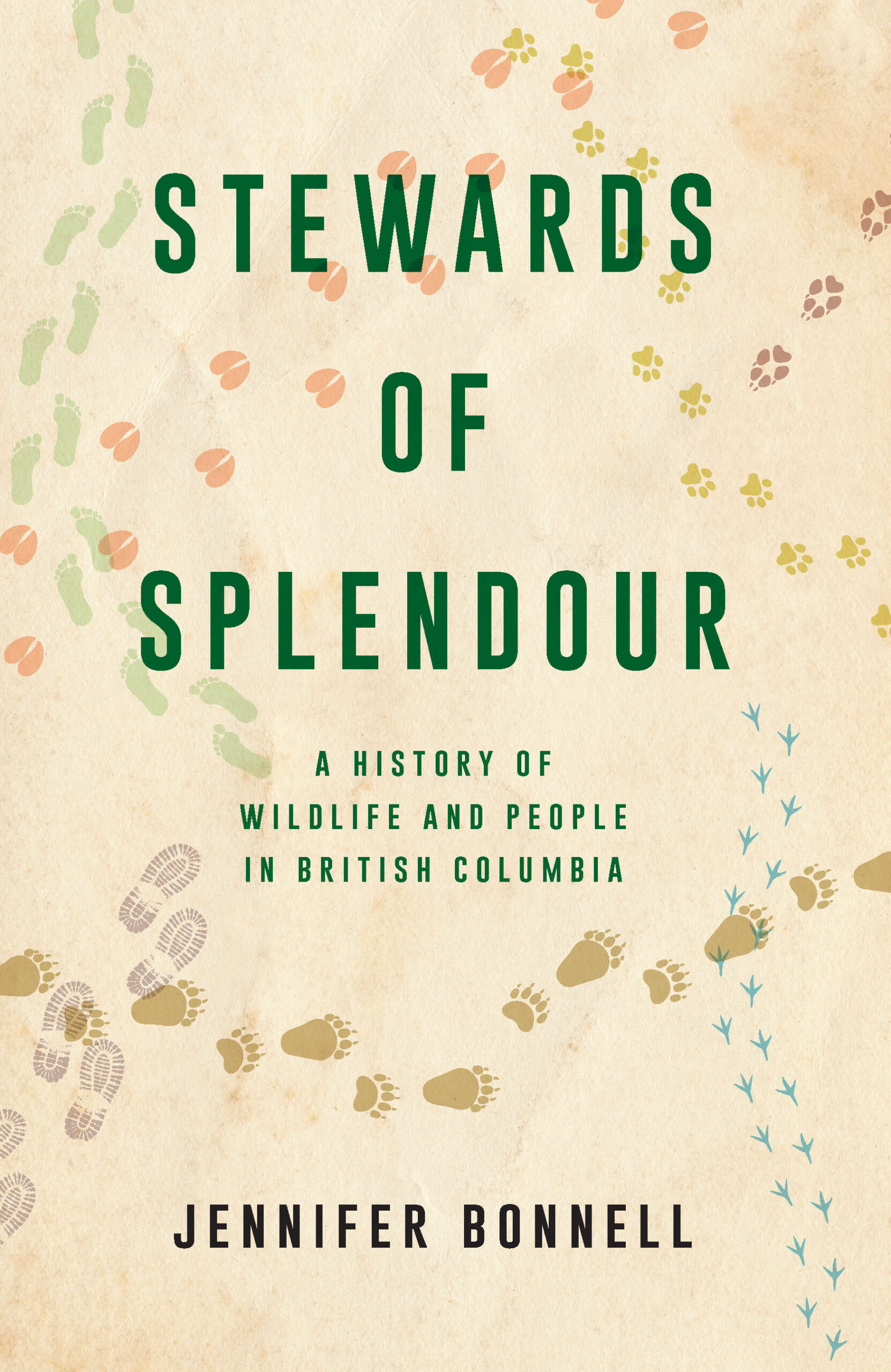
Stewards of Splendour: A History of Wildlife and People in British Columbia
Review By Glenn Iceton
October 9, 2025
BC Studies no. 227 Autumn 2025 | p. 205-206
British Columbia is the most ecologically diverse province in Canada, as evidenced by a colourful biogeoclimatic (BEC) zone map in one of the glossy centre plates of Stewards of Splendour. This diversity renders the task of writing a coherent environmental history of the province difficult. However, in Stewards of Splendour, Jennifer Bonnell rises to the occasion, providing a detailed and nuanced analysis of wildlife and people in British Columbia without leaving a corner of the province untouched. The result is a monograph that provides a solid general overview of changes in wildlife-human history in the province while also capturing its unique local dynamics.
Stewards of Splendour follows a chronological trajectory from Indigenous wildlife stewardship prior to the arrival of Europeans to more contemporary wildlife concerns. This narrative is divided into five parts and thirteen chapters. Following discussion of Indigenous wildlife stewardship, Bonnell transitions into examining the arrival of Europeans with the fur trade and the emergence of commercial exploitation of wildlife as well as the exploitation of the wildlife commons with the increase in settlers during the gold rushes. The book then considers the emergence of wildlife conservation in the early part of the twentieth century, its connections to sport hunting, and its consequent effects on Indigenous and other subsistence hunters. Following the emergence of wildlife conservation, Bonnell tracks the evolution of scientific wildlife management. This development entailed a movement away from sporting groups’ dominant positions with respect to wildlife legislation and initiatives. Bonnell also highlights the role of certain individuals, such as Ian McTaggart Cowan in facilitating these transitions. As Bonnell documents changes in wildlife conservation, she also analyses emerging threats to wildlife habitat, such as expanding settlement and the forestry industry. Towards the end of the book, Bonnell identifies important turning points influencing more contemporary wildlife-human attitudes, policies, and legislation. These turning points included changing public attitudes towards wildlife as well as developments around the rights of Indigenous peoples in the province, which have resulted in the latter assuming a more significant role in contemporary wildlife stewardship. Bonnell concludes Stewards of Splendour by reflecting on potential historical lessons. To this end, she draws attention to British Columbians’ mixed record on stewardship. In so doing, she highlights lessons from the past that need to be relearned, the need for a long-term vision, and the implications of changing public attitudes. Finally, recognizing that “individual actors can drive remarkable change” (422), Bonnell draws attention to three “change makers” charting the course of future wildlife stewardship.
While Stewards of Splendour’s primary focuses is wildlife, Bonnell brings it together with the histories of forestry, mining, energy infrastructure, settlement, and land use in general. Moreover, the book examines broader social, cultural, and political developments occurring in the province, such as the gradual recognition of Aboriginal rights and title by the federal and provincial governments and the province’s adoption of the United Nations Declaration on the Rights of Indigenous Peoples. This approach produces a truly ecological approach to understanding the history of wildlife. Bonnell is particularly effective at drawing attention to the pressures that the cumulative impacts of land use in its various forms have imposed on wildlife. This approach is particularly pertinent in the wake of the relatively recent Yahey case.
Bonnell uses a wide range of provincial and federal government records as well as legal decisions relating to Aboriginal rights in order to track wildlife-related developments in the province. Moreover, she draws on interviews with a myriad of participants in various initiatives. These interviews are significant as they allow readers to understand the rationales behind certain actions as well as the obstacles faced in these efforts that might otherwise not be apparent in the archival record.
One of the book’s most enjoyable features are the various profiles peppered throughout the general narrative of each chapter relating to specific wildlife species, initiatives, and individuals. These profiles offer readers an opportunity to explore individual facets of wildlife-related matters in the province in greater depth. Species profiles draw attention to specific animal species, such as sea otters and grizzly bears, and their distinct histories. For example, the species profile on sea otters (a keystone species) traces their extirpation from the North Pacific following the introduction of the maritime fur trade through to late twentieth and early twenty-first century efforts to restore the population. Meanwhile, the initiatives profiles draw attention to a vast array of projects and programs that have been used in British Columbia to protect, reintroduce, or repopulate certain wildlife species. These initiatives range from finding more humane ways to trap furbearing animals, to efforts to reintroduce certain animals (such as the California big horn sheep), to innovative co-management and land use planning projects. One particularly entertaining initiative was a brief effort to designate Ogopogo as “wildlife.” Finally, individual profiles draw attention to the role of various individuals in protecting wildlife. These profiles are significant as they demonstrate the potential of individuals to effect change. This is a theme that Bonnell returns to in the conclusion. It is through these profiles that Bonnell captures many of the nuances of wildlife history in the province.
Still another useful feature of this book is its comprehensive glossary. As much of Stewards of Splendour discusses wildlife conservation efforts, Bonnell frequently introduces technical jargon, such as “seral stage” in reference to the growth of plant communities. Moreover, given both the provincial and federal governments’ prominent roles in wildlife stewardship and their inclination to use acronyms, the glossary is a helpful tool for navigating these terms.
Overall, Stewards of Splendour makes a valuable contribution to Canadian environmental history and the history of BC. Bonnell captures the ecological, cultural, and social diversity of the province and how these intersected to inform approaches to wildlife stewardship. The book is a well-illustrated, engaging, and accessible read. While it does contain some technical jargon, the glossary allows the lay reader to navigate these terms. The book will likely have a broad appeal to environmental and animal historians, general outdoor enthusiasts, and, ideally, policy makers.
Publication Information
Bonnell, Jennifer. Stewards of Splendour: A History of Wildlife and People in British Columbia. Victoria:Royal BC Museum, 2023. 496pp. $ 34.95 paper.