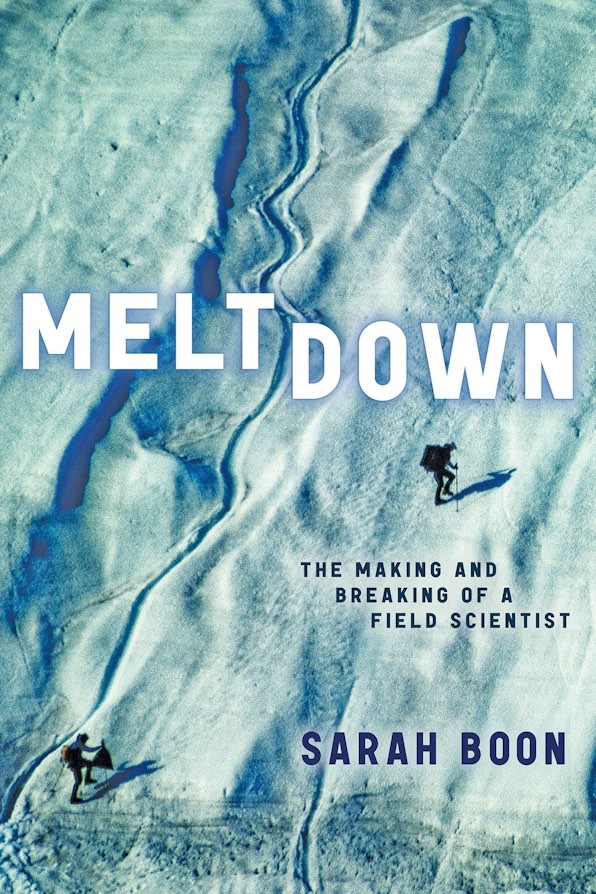
Meltdown: The Making and Breaking of a Field Scientist
Review By Michele Koppes
October 9, 2025
BC Studies no. 227 Autumn 2025 | p. 207-208
In Meltdown: The Making and Breaking of a Field Scientist, Sarah Boon shares her fraught journey through academia, fieldwork, science, womanhood and struggles with mental and physical wellness. Blending science writing and creative non-fiction, the author shares her adventures doing field research on the forests and glaciers of British Columbia, the High Arctic and the Canadian Rockies, and of finding her way on – and off – the academic career path. Through candid accounts of fieldwork, interactions with colleagues in grad school and beyond, and the elusive pursuit of academic work-life balance, Boon offers readers an intimate look at the highs and lows of a scientific research career.
At a time when the STEM disciplines, particularly the geosciences, are confronting a lack of diversity and a leaky pipeline for women and people of colour, Boon offers a deeply personal narrative of navigating the ‘glass obstacle course’ women scientists so often face in academic settings (NASEM, 2018; King et al., 2018; Marin-Spiotta et al., 2020). Woven into her own narrative are similar successes and struggles of other Canadian women scientists, including contemporaries Alison Criscitiello, Bea Alt, and Rita Winkler, and pioneers Mary Vaux, Mary Schäffer, and Phyllis Munday. As she battles both challenging physical environments and the interpersonal dynamics of being thrown together with challenging field companions, Boon’s personal experiences spotlight the misogynistic attitudes that are still pervasive in glaciology and other remote field disciplines (as also seen in the 2020 documentary Picture a Scientist). Boon’s unflinching honesty about the barriers and undue expectations placed on women in science will resonate with many others in academia. Indeed, her story resonated – at times a little too painfully — with my own experiences as a female scientist navigating the twin minefields of remote polar fieldwork and hostile academic settings.
Meltdown is also a cautionary tale for graduate students embarking on an academic career, providing an intimate portrait of struggles with lack of mentorship, imposter syndrome and mental illness in academic spaces, parts of the hidden curriculum of graduate school not often talked about (Calarco, 2020). As she summarizes the graduate experience in a single sentence: ‘If there’s one universal truth about a graduate degree, it’s that it will tear you down and then build you back up again in the shape of an academic who questions everything – including yourself…I started to question my intelligence: was I smart enough to do a PhD?’ (111)
Armchair adventurers will be drawn to the detailed passages of seasons spent planning and conducting fieldwork in the remote outposts of Ellesmere Island and the Canadian Rockies, of living on a glacier as it comes to life, of rescuing equipment, tents, and teammates from raging rivers and curious bears. Boon’s experiences are also a reminder that the process of discovering new knowledge is inevitably messy, fraught, and uncertain. As she shares, ‘science doesn’t always provide cut-and-dried answers to difficult questions, that sometimes there is no alternate hypothesis for your results, and that things often don’t work out quite as expected.’ (51).
Meltdown is as engaging and readable as it is academically rigorous. Each of the ten chapters is organized and generously supplemented with relevant academic literature and photographs from the author’s many forays into the field. Beyond sharing her lived experience, Boon offers critical insights into the complexities of documenting climate change in Canada’s icy places, and the toxicity found in academia. Readers drawn to narratives of adventure and scientific exploration, as well as those looking for a raw and honest look at the challenges of being a woman in academia, will find much of interest in this book.
REFERENCES:
National Academies of Sciences, Engineering, and Medicine (NASEM), 2018. Sexual Harassment of Women: Climate, Culture, and Consequences in Academic Sciences, Engineering, and Medicine. Benya, F.F, Widnall, S.E., Johnson, P.A (eds): Washington: National Academies Press. http://www.ncbi.nlm.nih.gov/books/NBK507206/
King, L., MacKenzie, L., Tadaki, M., Cannon, S., McFarlane, K., Reid, D., and Koppes, M., 2018. Diversity in geoscience: Participation, behaviour, and the division of scientific labour at a Canadian geoscience conference. Facets, 3(1), 415-440.
Marín-Spiotta, E., Barnes, R. T., Berhe, A. A., Hastings, M. G., Mattheis, A., Schneider, B., and Williams, B. M., 2020. Hostile climates are barriers to diversifying the geosciences, Advances in Geosciences, 53, 117–127.
https://www.pictureascientist.com/
Calarco, Jessica M., 2020. A field guide to grad school: Uncovering the hidden curriculum. New Jersey: Princeton University Press, 480 p.
Publication Information
Boon, Sarah. Meltdown: The Making and Breaking of a Field Scientist. Edmonton: University of Alberta Press, 2025. 312 pp. $ 27.99 paper.