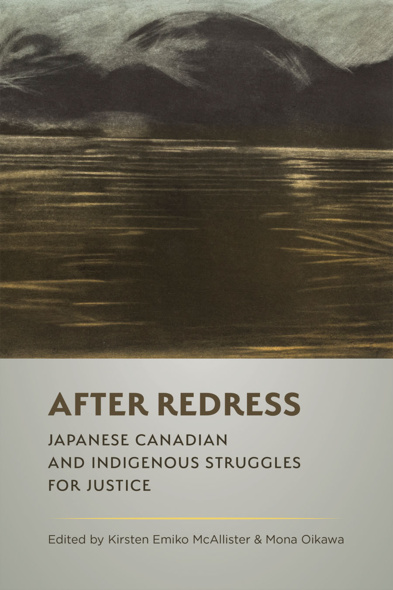
After Redress: Japanese Canadian and Indigenous Struggles for Justice
Review By Eiji Okawa
September 9, 2025
BC Studies no. 227 Autumn 2025 | p. 198-200
After Redress brings together Japanese Canadian and Indigenous scholars as well as a specialist of Canadian literature to examine the legacies and implications of community-based political activism. Edited by Kirsten Emiko McAllister and Mona Oikawa, it is a first book-length academic work that bridges Indigenous and Japanese Canadian struggles to hold the state accountable for historical and on-going injustices. Featuring contributions by eight authors, it is mightily critical, theoretically dense, and rich in interpretive frameworks. It embraces diverse positions and outlooks, both of the contributors themselves and of the subjects they seek to represent. There is simply no way to do justice to its contents in a short review like this. But a question posed by Dorothy Cucw-la7 Christian in her chapter helps to highlight its key ideational thrust: “What is it going to take to transform the embedded national colonial narrative so that the grandchildren and great-great-grandchildren of both Indigenous and settler peoples can share a sustainable future on these lands that could be mutually beneficial to all?” (101).
The book marks a milestone in the formation of an anti-racist coalition that is necessary to effectively counter hegemonic forces that are entrenched in state apparatuses. To be sure, the contributors emphasize the “incommensurability” of Indigenous peoples and Japanese Canadians who, in McAllister’s words, are “racialized settlers profiting from the genocidal occupation of the unceded territories of hundreds of sovereign Nations whose rights Canada continues to violate” (214). Bearing this “foundational difference” in mind, it is still possible to examine Indigenous and Japanese Canadian calls for justice in cross-pollinating ways (14). Bonita Lawrence writes, “[i]n examining the largest redress settlement in Canadian history – the Indian Residential Schools Settlement Agreement (IRSSA) – I have found it useful to first of all consider the Japanese Canadian struggles for redress, as it was the first successful struggle toward restitution for past wrongs that profoundly shaped the possibilities for the IRSSA, as well as the latter struggles of survivors of the Sixties Scoop,” both of which were woefully inadequate (28).
What the book explicitly opposes includes settler colonialism, multiculturalism in its official manifestation, liberalism, state apologies, linear and homogenizing conception of time, historians’ valorization of “objectivity” and their treatment of the past as finished, and subject formation in its universalizing Western variant. Each tacitly packs the power to exclude and erase, and they are woven together in some of the “the insidious ways that power can incorporate what it seeks to destroy” (6). Communities are silo-ed and selfhoods are depoliticized, paving the way for dominant conceptions that bolster the ruling power to extend further and deeper. Much of the book is devoted to outlining communal practices for thwarting and debasing these effects. If “redress” implies a closure, that is a fallacy induced by the “liberal script” mobilized by the state. This is why the “after of redress” becomes critical. As Smaro Kamboureli suggests, the said script is foregrounded with a linear and homogenized “Canadian settler state’s time” which holds within, or is inextricable from, “the Western mould of subject formation, when in fact these subjects [who are redressed] have been typically those whose difference Western liberal states have tried to eradicate or contain” (186, 170). By lingering on the “after,” we can open pathways to disrupt the pull towards closure and recognize the different temporal orders that are active in given moments. Kamboureli offers an eye-opening analysis of Anishinaabe elder Fred Kelly’s and Japanese Canadian scholar Roy Miki’s brilliant strategies to resist, undermine, and subvert power’s hold.
In recent critical scholarship, state apologies have been framed as “motivated primarily by the desire to preserve their reputations nationally and internationally…[and that] states apologize and agree to reparations while avoiding the implementation of structural changes that ensure justice for survivors and ending further violations” (3). After Redress works with this line of understanding, but it is distinctive in that its “contributors…write from and about the positionalities ‘inside the call[s] for justice’ for Indigenous peoples and Japanese Canadians” by accessing “insider knowledge” not available in public archives (5, 12). What is more, McAllister and Oikawa are wary of a trend wherein activism is grasped as being co-opted by the state, after all. This signals a danger of “these movements [being reduced] to some scholars’ assessments of their co-option” (7). What can hard-fought struggles of communities teach us? Who are we, as outsiders, to take the posture of aloofness and discuss, in a totalizing and preordained manner, their functional effects? At stake is not so much coming to know some reality out there, but rather, how we come to understand “our constitution as (a)political subjects today” (8). McAllister and Oikawa call for a rigorous self-reflexivity, for, if we ignore how our selves are formed in relation to the encompassing schemes of power that surround us, how is it possible to bring about structural change?
The book successfully demonstrates that activism and legacies thereof deserve full scholarly attention especially when they fuse and promote solidarity among Indigenous and other marginalized groups in Canada’s settler colonial order. It is a superbly enriching read, and it should move and inspire scholars and activists as well as storytellers and artists for years to come. Much more work is needed to expand the scope of this kind of discourse.
Publication Information
McAllister, Kirsten Emiko, Mona Oikawa, eds. After Redress: Japanese Canadian and Indigenous Struggles for Justice. Vancouver: UBC Press, 2025. 302 pp. $ 34.95 paper. $ 99 hardcover.