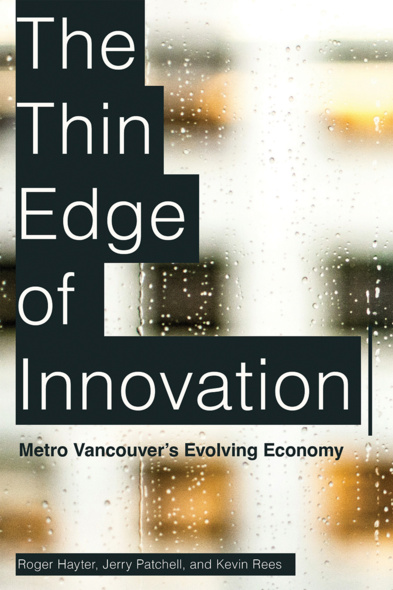
The Thin Edge of Innovation: Metro Vancouver’s Evolving Economy
Review By Jamie Peck
September 9, 2025
BC Studies no. 227 Autumn 2025 | p. 191-192
“Silicon envy” has been a persistent trope in the urban and regional development community for decades now, reflecting a widespread desire to emulate the storied high-tech growth model of Silicon Valley in California. Scotland has a silicon glen, New Orleans its silicon bayou, and there are numerous silicon prairies and savannas. Canada has periodically laid claim to a nebulous silicon north. But there is nothing to match the Californian original, which has surged through decades of reinvention (from hardware and then networks to software and platforms) in a peerless fashion. In truth, Metro Vancouver has never been a serious player in this world. The Thin Edge of Innovation, by economic geographers Roger Hayter, Jerry Patchell, and Kevin Reese, shows why.
Metro Vancouver’s is ultimately a story of “arrested development,” which could have been an alternative title for this book. There is a reasonable record of homegrown entrepreneurship, the region’s modestly sized tech sector being mostly populated by micro-enterprises. But hardly any have grown into so-called core firms, capable of anchoring an innovation ecosystem, and virtually none of the self-reinforcing agglomeration economies depicted in the innovation literature. This book strives to make the most of Vancouver’s scattered achievements, but there is no escaping its sobering conclusions: that the metropolitan region’s tech economy is “distinctive” but not “substantial,” that it is “limited in size and spread thin without sinking many local roots” (229), that clustering effects are “modest” (213), and that public-policy efforts have been “ad hoc” (64).
Guided by the expansive literature on innovation economies—which has more than its fair share of tautological and circular reasoning, reading back from demonstrated success stories for causal factors and replicable formulas—Hayter and colleagues embark on a determined search for anything that might credibly be framed in such terms. They leave no stone unturned in documenting all that there is, providing pen portraits of local firms, mapping financial relations and export markets, and putting a positive gloss on the efforts of local institutions. But these are thick descriptions of substantially thin processes.
The authors show that British Columbia’s resource economy, downsized and heavily restructured since the 1980s, left behind a legacy ill-suited to the needs and priorities of the knowledge-based industries of today. On the other hand, most of Vancouver’s best-known companies—such as Lululemon, Mountain Equipment Co-op (now Company), Aritzia, and Arc’teryx (Table 6.1, 202-204)—are brand-led players occupying the pricier parts of “lifestyle” markets. These companies trade on the image of Vancouver, placing an accent on design, but they are “not necessarily high tech” (196). If there is a bona fide high-tech sector, it is the “new media” cluster that grew up around video-game production with close links to the movie industry. This is arguably the only part of Metro Vancouver’s bits-and-pieces economy that resembles the textbook cases of creative dynamism, talent pooling, innovation-rich commercialization, and dense inter-firm networking. But even this sector struggles to sustain forward momentum in a metropolitan region burdened by a long-term affordability crisis, shortages of local venture capital, and limited institutional capacity.
In effect, The Thin Edge of Innovation conclusively demonstrates its null hypothesis, providing a stock-take of Metro Vancouver’s arrested development in high tech. Less than one-tenth of the size of the Silicon Valley original, Vancouver barely registers on the list of wannabes, and it is not difficult to see why. There are good universities, but not many commercial spin-offs. There is plenty of talent, but not enough decent-paying jobs. There are generally supportive politicians, agencies, and civic leaders, but more self-congratulatory rhetoric than substantive institutional or financial support. It’s said that Vancouver gets by on its wits and its good looks, which may be about right. There are surface trappings of success—such as busy restaurants and above-average ownership of luxury cars (200)—but to look beneath the surface, as Hayter and colleagues do, is to raise more troubling questions.
A telling episode not mentioned in the book is Vancouver’s ill-fated (and ill-conceived) bid to host Amazon’s second headquarters (HQ2) in 2017, which laid claim to a curious competitive asset: “we have the lowest wages of all North American tech hubs” (Vancouver Economic Commission, 2017: 2, 51). A point that Hayter and colleagues mention, but do not dwell upon, is that in North America, only Mississippi and South Dakota have lower tech-sector wages than Metro Vancouver (112). Yet they dismiss as “churlish” the suggestion that Metro Vancouver has been stuck on a “low- road” development path (8). Although this is anything but a typical cheap-labor economy, the (unnamed) development model that the city has been pursuing does not appear to have been working—at least not for the majority of local workers. Despite the fact that Hayter and colleagues prefer to pull their punches, chasing the holy grail of high-tech growth, on this evidence, is not going to be the answer.
REFERERENCE
Vancouver Economic Commission. 2017. Vancouver: We Are Home. Vancouver: VEC.
Publication Information
Hayter, Roger, Jerry Patchell, and Kevin Rees. Thin Edge of Innovation: Metro Vancouver’s Evolving Economy. Vancouver: UBC Press, 2024. 344 pp. $99 hardcover, $34.95 paperback.